Myrtle Oil Blends: Which Oils Pair Well and Why
Myrtle is the kind of oil that makes a blend smell tidier. We describe its aroma as fresh, clear and gently floral, with a soft eucalyptus-like coolness and a faint honeyed sweetness, and we place it as a top-to-middle note. That means it opens bright and then stays around long enough to meet the heart of a blend. Here is how we would think about pairing it.
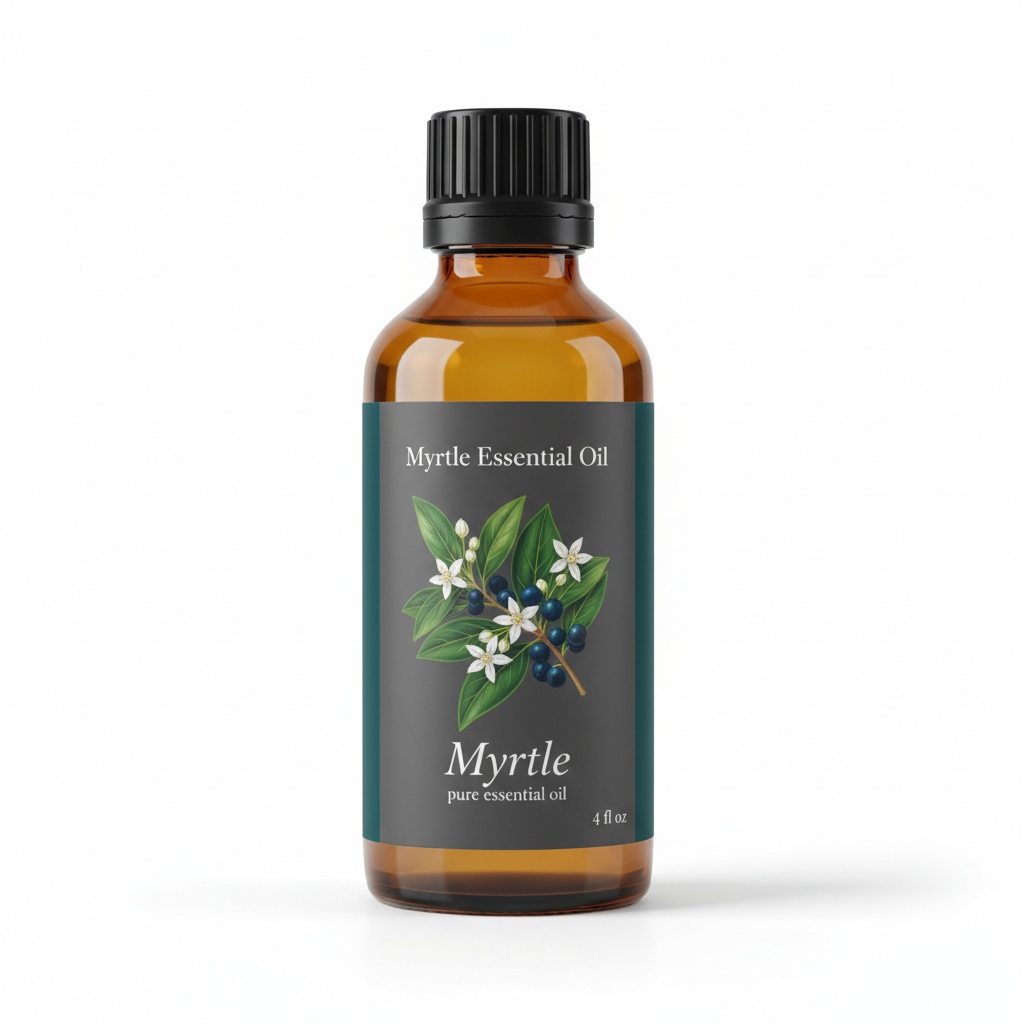
Myrtle Essential Oil
Our own Myrtle Essential Oil, in sizes from 0.5 oz to bulk.
From $16.99
Shop Now →Four directions to take it
The oils we suggest alongside myrtle are lemon, lavender, rosemary, neroli and clary sage, with bergamot and eucalyptus as further options. They fall into a few natural families, and thinking in families is easier than memorizing a list.
- Citrus (lemon, bergamot). Citrus adds sparkle on top of myrtle's green freshness. This is the most obvious direction and the easiest to get right.
- Florals (lavender, neroli, clary sage). These lean into the soft, honeyed side of myrtle and slow the blend down, which suits a calmer room scent or a cologne with some depth.
- Herbal and cool (rosemary, eucalyptus). Both share myrtle's cool edge, so they sharpen it. They make an energetic, clean-smelling blend.
We do not sell any of the partner oils, so an aromatherapy or craft supplier is the place to find them. For how myrtle smells on its own, start with our scent profile. Our rosemary comparison and eucalyptus comparison look at the cool-and-herbal partners in more detail. Our own myrtle is in our shop, and our bulk page and guide to buying myrtle oil in bulk cover larger sizes.
Smell before you commit
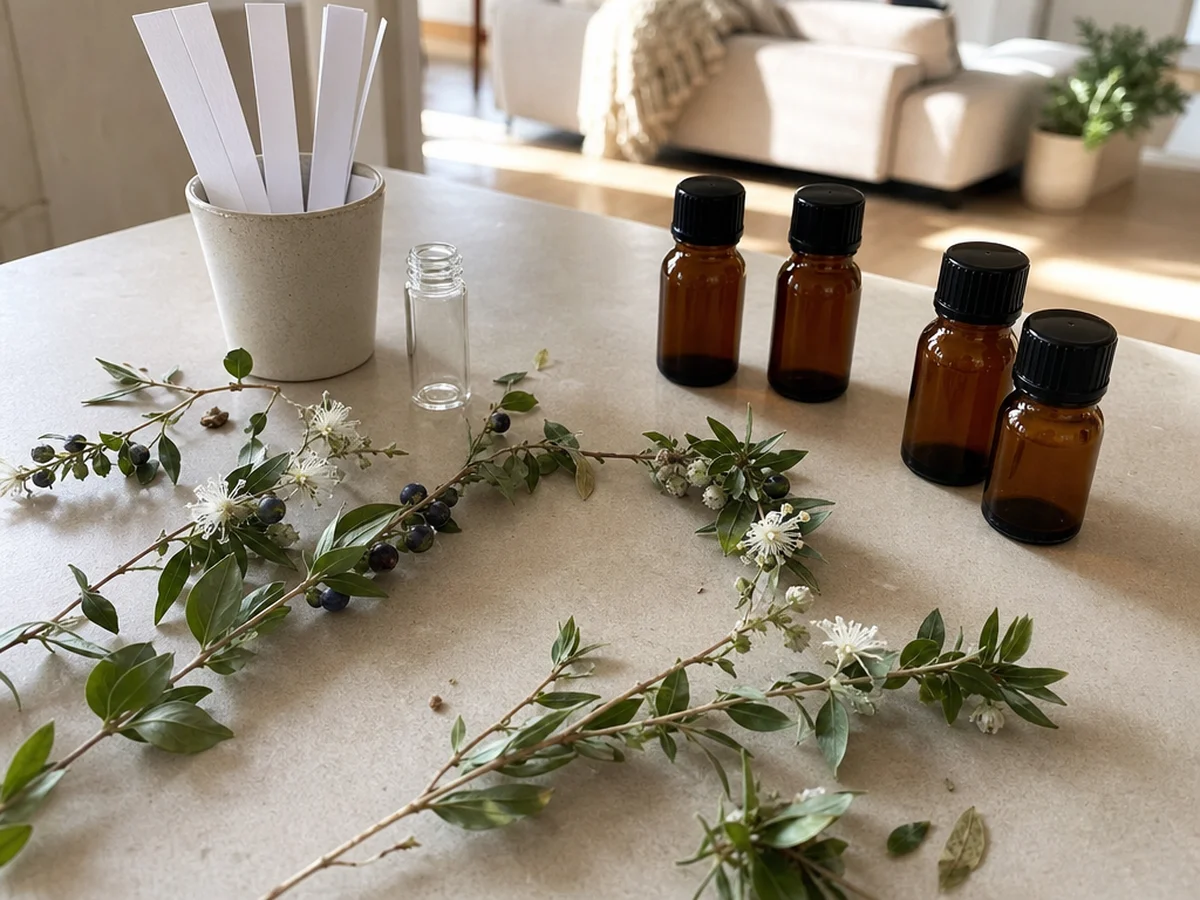
Before you measure anything, open the myrtle bottle and take a slow sniff, then do the same with a partner oil. Dip a strip of plain paper in each, wave them gently, and hold the two strips together a few inches from your nose. You will notice which oil arrives first and which one lingers, and that tells you more than any list of pairings can. Come back to the strips ten minutes later and again an hour later, because a top-to-middle note like myrtle changes as it sits.
Think in shares, not drops
The most useful habit in blending is to decide the total essential oil percentage first, then give each oil a share of it. For example, a body oil at 1% total essential oil is about 1 ml in 100 ml of carrier, or around 20 drops at the usual rough convention of 20 drops per milliliter (weigh instead if you can). If myrtle makes up a quarter of the blend, that is 0.25% of the finished oil, about 5 drops. That is a worked suggestion, not a tested recipe, and it makes the maths easy to adjust. Our roller blend post and massage oil post use the same method.
What sets the ceiling
The product you are making limits how much myrtle it can carry. IFRA's standards cap methyl eugenol, a constituent myrtle oil can contain, by product category: 0.011% of the finished product for cologne and aftershave (Category 4), 0.0015% for body oils and lotions (5A), 0.0021% for manual room sprays (10B) and 0.0017% for bath products and bar soap (9). Dividing each cap by the methyl eugenol share of an oil gives a maximum myrtle share. Published samples run from 0.2% in a Corsican leaf oil to a mean of 1.40% across 19 Algerian localities. A GC/MS report for one supplier's lot gave 0.40%.
At 0.40%, cologne can hold about 2.75% myrtle and a body oil about 0.375%. At 1.40%, those figures fall to about 0.79% and 0.107%. So our 0.25% body oil sits under the ceiling in one case and over it in the other, depending on a number that our Certificate of Analysis, which lists density and refractive index for one batch, does not print. The sensible reading is to take the stricter case unless you hold a constituent report, which you can ask us for in writing through the contact page before ordering. These are our calculations, and IFRA writes its standards for commercial products, but they are a useful guide for home blenders too. Cologne has the roomiest ceiling of the four, which makes it a forgiving first project.
Each partner brings its own limits
Bergamot is the clearest example. The Tisserand Institute explains that expressed citrus oils carry furanocoumarins, which make skin react to sunlight, while distilled citrus oils contain virtually none. For bergamot, it quotes an IFRA limit of 0.4% oil in leave-on products on sun-exposed skin and advises keeping treated skin out of UV light for at least 12 hours. Check whether any citrus oil you buy is expressed or distilled, and let the label guide the amount.
Lavender and lemon matter for a different reason. Linalool and limonene, terpenes myrtle already carries, form hydroperoxides as oils age, and a review of fragrance allergy names those as the major allergens among common fragrance terpenes. Several bottles in a blend means several places for ageing to start, so fresh oils, tight caps and a date on each bottle are good habits.
Rosemary and eucalyptus share myrtle's cineole side. Tisserand's rule, as quoted on a supplier page, is that oils with 40% or more 1,8-cineole should not go on the faces of infants or children or be inhaled by them. Stacking cineole-rich oils moves a blend further toward that line, so we keep those blends away from children altogether. Our safety post gathers the cautions that apply to a whole blend.
How we would build one
Name the product first, since the product sets the ceiling. Pick two partner oils at most; a short blend is easier to balance and easier to troubleshoot than a "complete" blend of six. Write each oil as a share of the total, smell the result on a blotter before it goes into a bottle, and patch test the diluted blend. Myrtle brightens almost anything it touches, so a small share often does the job.
Myrtle Essential Oil
Myrtle Essential Oil from our own shop, in sizes from 0.5 oz to bulk.
From $16.99
Shop Now →Sources & Further Reading
- International Fragrance Association, IFRA Standards, 51st Amendment (methyl eugenol standard). ifra-standards-51st-amendment.pdf
- International Fragrance Association, Guidance for the Use of IFRA Standards (June 30, 2023). ifra-51st-amendment-guidance-for-the-use-of-ifra-standards.pdf
- Hardy et al., Quorum-Quenching Activity of Myrtus communis Corsican Essential Oil Against the Marine Bacterium Aliivibrio fischeri, Microorganisms, 2025. PMC12195544
- Mohamadi et al., Chemical composition and antimicrobial activity of Myrtus communis essential oils from Algeria, Biodiversitas, 2021. smujo.id/biodiv/article/view/7327
- Hopewell Essential Oils, Myrtle (product page with a GC/MS lot and Tisserand's cineole rule). hopewelloils.com/myrtle.php
- Tisserand Institute, Phototoxicity: essential oils, sun and safety. tisserandinstitute.org/safety/phototoxicity
- Uter, Contact allergy to fragrances: current clinical and regulatory trends, Allergologie Select, 2017. PMC6040011