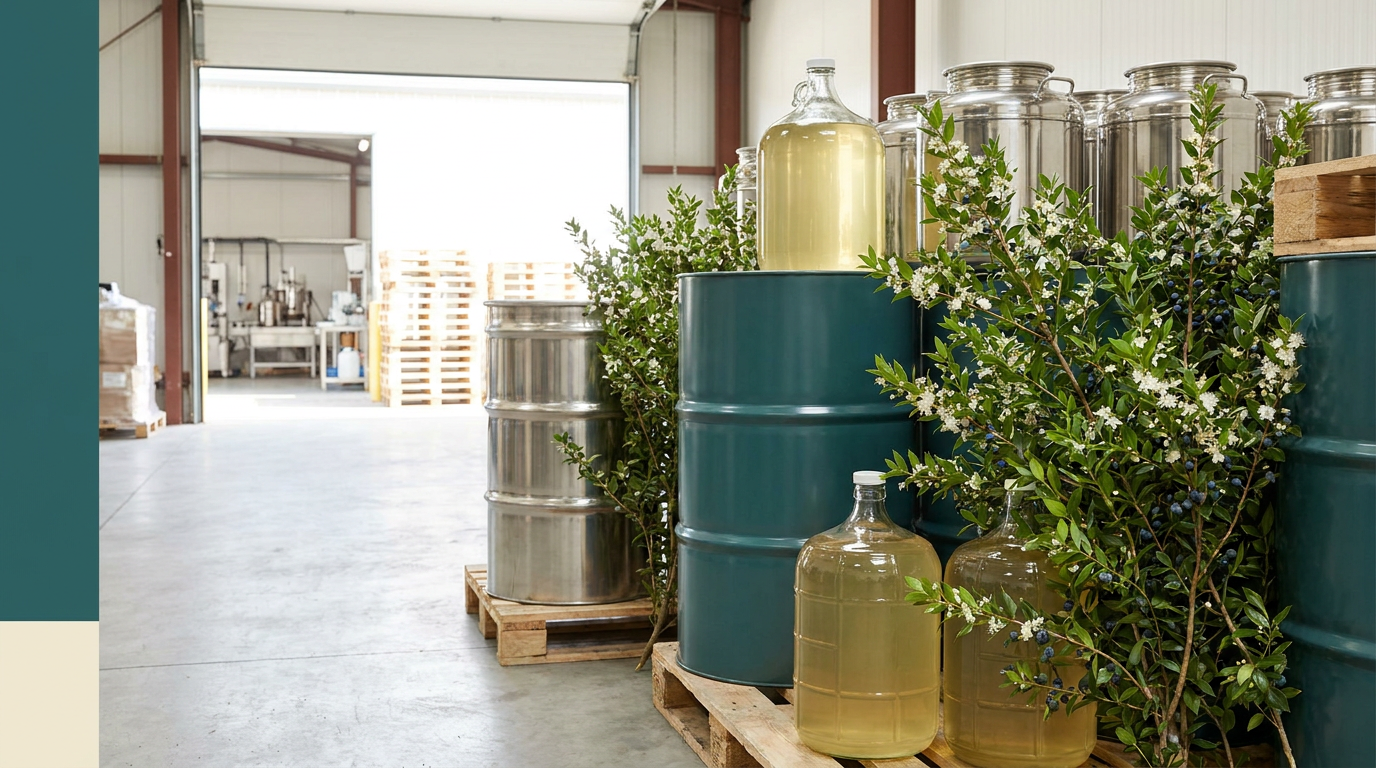
Myrtle essential oil is a niche but dependable wholesale ingredient: steam distilled from Myrtus communis leaves and twigs, it brings a fresh, eucalyptus-cool top note with a soft honeyed floral finish that soap makers, skincare formulators, and fragrance brands reach for when they want green without harshness. This guide covers how the oil is actually sold, what separates a documented lot from a guess, and which of our ten stocked sizes fits a trial order versus a production run.
Request a batch COA and current bulk pricing before you commit to volume.
Myrtle oil comes from steam distilling the leaves and twigs of Myrtus communis, an evergreen Mediterranean shrub grown from Corsica to Morocco. How Myrtle Oil Is Made walks through that distillation in detail: green myrtle, cut from fresher growth, yields the brighter, cooler profile we stock, while material cut later in the season shifts heavier and more resinous.
Buyers who have only worked with straight eucalyptus or rosemary sometimes expect myrtle to smell the same way. It does not: our scent profile breakdown describes a top note that is fresh and clear with a cool eucalyptus-like edge, softened almost immediately by a sweet floral, faintly honeyed undertone that keeps it out of the sharp, camphoraceous register those other leaf oils sit in. That balance is why formulators pair it with lemon, lavender, rosemary, and neroli rather than reaching for it alone, a pairing logic our blending guide covers in more depth.
Origin and chemotype both move the bottle. Corsican, Moroccan, and Tunisian material can differ in brightness and yield, and green and red myrtle are genuinely different chemotypes, not just marketing names. A wholesale buyer who cannot tell the two apart on paper is buying blind.
| Sold as | What it actually is | How to recognize it |
|---|---|---|
| Green myrtle | Distilled from fresher green growth, the brighter chemotype we stock | A cooler, clearer top note with less resinous heaviness on the strip |
| Red myrtle | A separate, heavier chemotype from later-season or different growth | A denser, more resinous smell that reads darker than green myrtle |
| Lemon myrtle | An entirely different plant, Backhousia citriodora, not Myrtus communis at all | A sharp, citronella-like citrus smell with none of myrtle's soft floral edge |
| Origin-labeled lots (Corsican, Moroccan, Tunisian) | The same species grown in different Mediterranean regions | Subtle shifts in brightness and yield rather than a different smell entirely |
Our label-reading guide goes through how a supplier should state species, chemotype, and origin on paper rather than leaving a buyer to guess from the bottle alone.
The costliest sourcing trap in this category is not a fake oil, it is an unlabeled chemotype. A drum billed simply as 'myrtle oil' with no species, chemotype, or origin statement could be green myrtle, red myrtle, or lemon myrtle blended in to stretch the batch, and a formulator who builds a signature scent around one lot has no guarantee the next drum matches it.
The realistic wholesale buyer for this oil is a small or mid-size brand building around scent rather than a bulk commodity trader. Cold process soap makers use it for a green, non-drying top note, as our soap maker's trial documents in detail, including how the scent behaves through cure. Home fragrance brands building room sprays want the same cool, clean lift for a living space, and skincare formulators building facial mists or aftershave splashes want a soft green note that will not overpower a close-contact product.
What these buyers have in common is a need for consistency across a production run, not a single bottle. A brand that builds a signature blend, like the one detailed in our Mediterranean Morning blend, needs the same lot character in the hundredth batch as the first, which is why documentation and origin transparency matter more here than for a generic filler ingredient.
Before committing to a drum, confirm the following on any supplier's listing or spec sheet.
Treat the Certificate of Analysis as the deciding document, not a courtesy add-on. If a supplier cannot produce a batch-specific COA on request, that alone is reason to keep the order at trial size until they can.
Our ten stocked sizes run from a 0.5 oz sampler up through 400 lb drums, which lets a buyer move from a first smell test to a full production order without switching suppliers.
Most wholesale buyers land in the 5 lbs to 100 lbs range for a first production run, stepping up to 400 lbs once a formula is locked and reorder volume is predictable. See our bulk pricing for current per-size figures.
Start with a small bottle, 1 oz or 2 oz, to confirm the lot's scent against your formula before committing to volume.
Request the batch COA and check species, chemotype, and origin against what the listing claims before placing a production order.
Move to a 5 lbs or 25 lbs case for a first production run, sized to how much of the formula you expect to sell before the next reorder.
Step up to 100 lbs or 400 lbs once volume is predictable, and ask whether the new drum's COA matches the reference profile from your original order.
The sections below cover the wholesale categories that actually buy this oil, with the sourcing and sizing questions specific to each.
Myrtle's green, non-drying top note holds up through cure better than most leaf oils, without the sharp bite of straight eucalyptus.
Read the sourcing guide →A cool, green top note built for a light water-based mist, reading as fresh the moment it settles rather than sharp or heavy.
Read the sourcing guide →A crisp, wake-up scent for shower melts and steamers, built to hold up against heat and moisture rather than fade in the first few minutes.
Read the sourcing guide →A gentle green note for facial steams, mists, and body-care blends, dosed at a much lighter rate than a room fragrance.
Read the sourcing guide →A top-to-middle note that gives colognes and aftershave splashes a clean Mediterranean lift without competing with citrus or herb notes.
Read the sourcing guide →A green, wake-up top note for pre-blended diffuser products, formulated to round out over a full diffusing session rather than read as one-note.
Read the sourcing guide →Our bulk pricing covers every size from 5 lbs case lots to 400 lb drums.