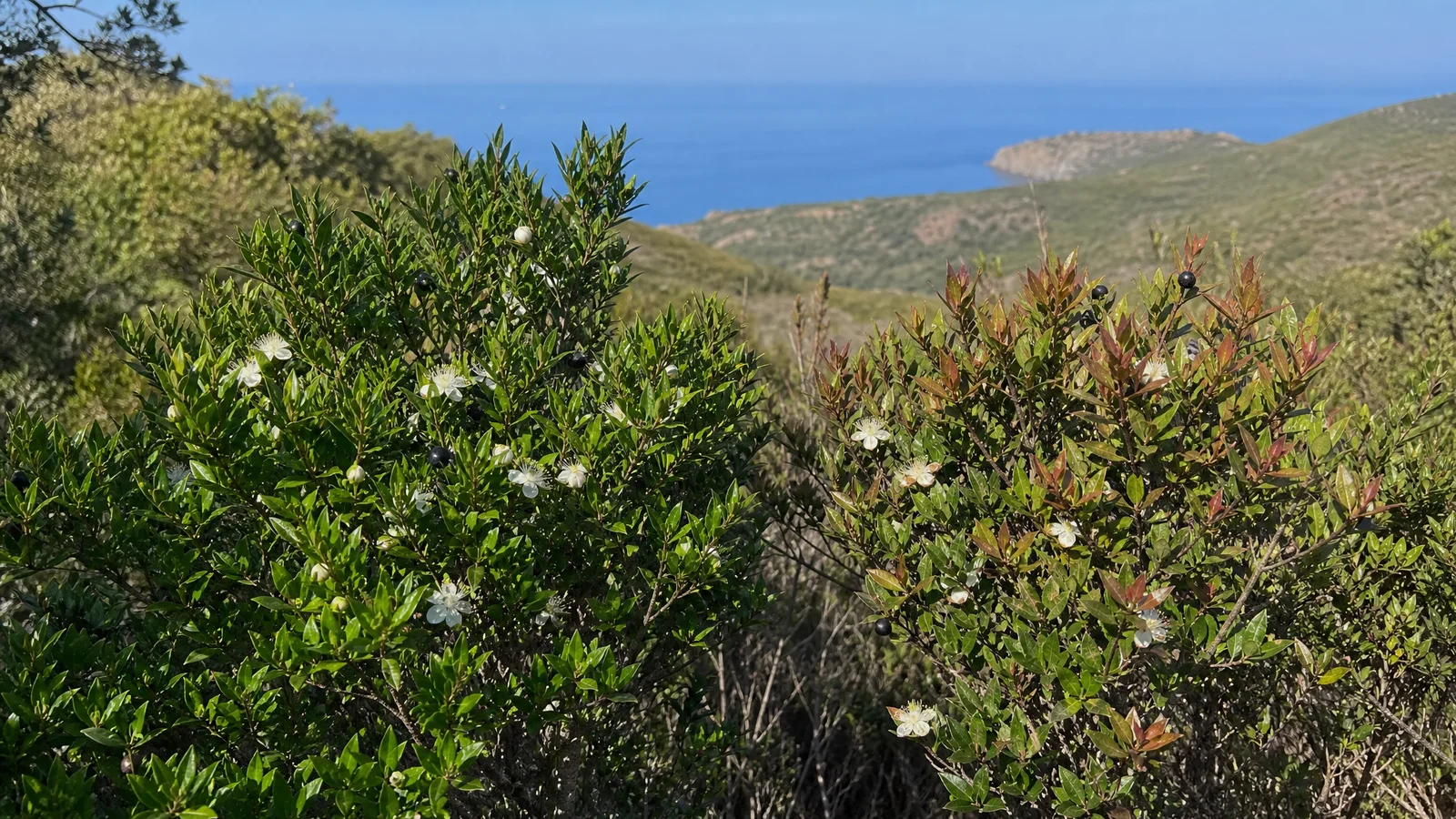
Green vs Red Myrtle Oil: What the Labels Really Mean
Ask three suppliers about "green myrtle" and "red myrtle" and you may hear three slightly different answers. The terms are real, and they are useful shorthand. They are also trade labels laid over a spectrum, which makes the numbers on a report more informative than the colour on a listing.
Myrtle Essential Oil
Our own Myrtle Essential Oil, in sizes from 0.5 oz to bulk.
From $16.99
Shop Now →Where the two names come from
Robert Tisserand, an author of the standard aromatherapy safety text, describes the split in terms of the oils on the market: green myrtle is high in myrtenyl acetate and linalool and is produced in Corsica, while red myrtle refers to the cineole-rich type available from Morocco. That is a description of trade oils, not a botanical classification, and the real chemistry is messier. The same supplier's own red Moroccan lot, for instance, lists 1,8-cineole at 27.07%, but also alpha-pinene at 49.45%, myrtenyl acetate at 18.93% and linalool at 5.16%. A cineole-rich red oil should lead with cineole, and this one leads with pinene while carrying plenty of the compound that "green" is meant to own.
What published samples show
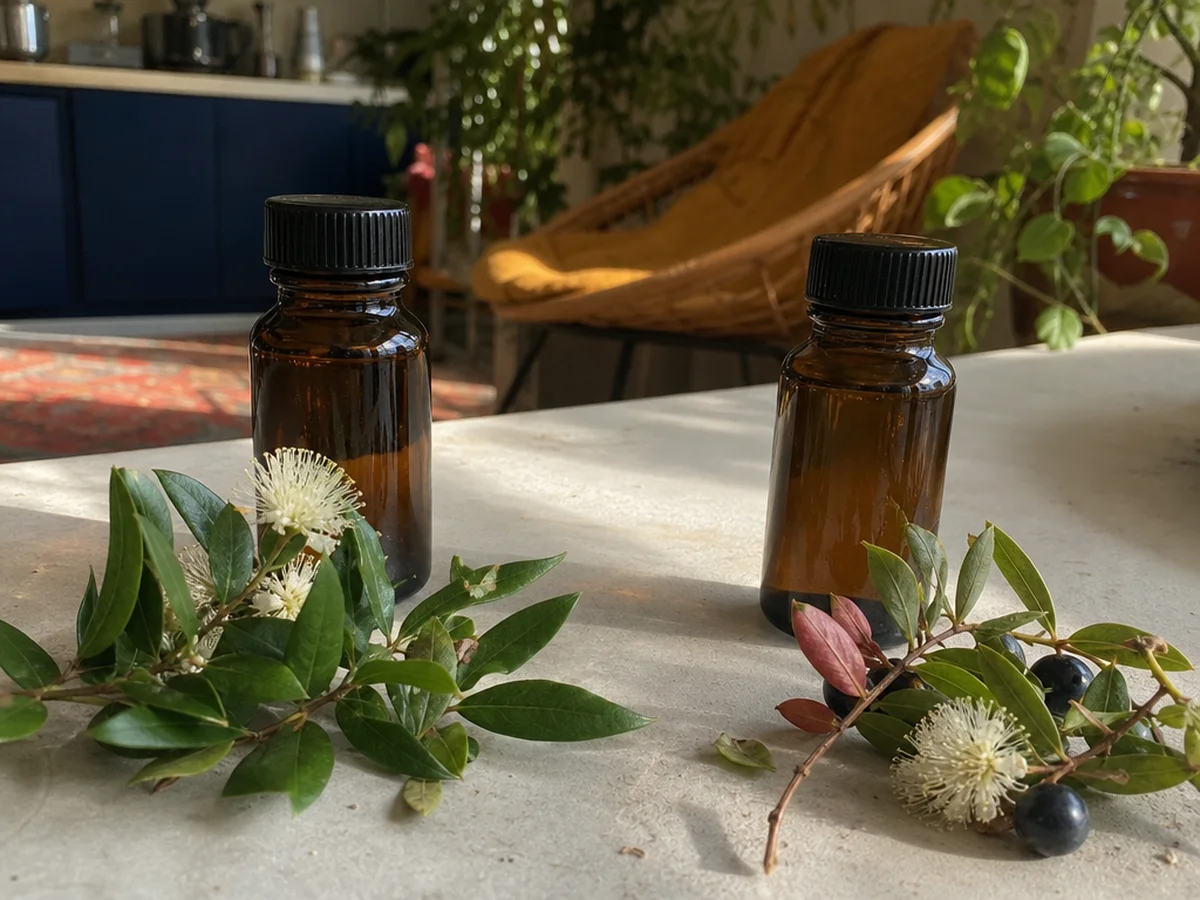
Published analyses of Myrtus communis leaf oil move around from one place and one plant to the next:
- A Corsican producer's oil had 28.8% 1,8-cineole and 43.0% alpha-pinene (the paper does not report myrtenyl acetate or discuss chemotypes).
- A leaf oil from Ourika in Morocco had 42.22% 1,8-cineole, 17.56% alpha-pinene and 15.06% myrtenyl acetate.
- Across 19 coastal localities in Algeria, mean 1,8-cineole was 22.27% and alpha-pinene 50.1%, and myrtenyl acetate was notable (10.66% to 20.94%) in only four populations. The authors identified six chemotypes.
None of these papers claims that country predicts type, and the figures do not prove that it cannot. They do suggest that a country name on a label narrows the possibilities only so far.
The strongest evidence: one field, many plants
The most telling study grew 52 myrtle genotypes in a single Sardinian field, so soil and climate were the same for every plant, and harvested leaves in July 2015. Reading the authors' tables, 1,8-cineole ran from about 1.4% to 27.1%, alpha-pinene from about 13.8% to 46.5%, linalool from under 1% to about 24%, and myrtenyl acetate was under 1% in most plants but near 28% in a few. The authors found no homogeneous groups of accessions. Genetics alone moved the main compounds over wide ranges, and a lot distilled from many plants can land almost anywhere between the two trade poles.
Why it matters in practice
Aroma comes first. The red entry we quoted describes its oil as fresh, camphoraceous and sweetly herbal, similar to eucalyptus, while we describe ours as fresh, clear and gently floral with a soft cool edge and faint honeyed sweetness. We describe our oil as a green myrtle profile. Those are descriptions of scent, and the bottle in your hand is the real test.
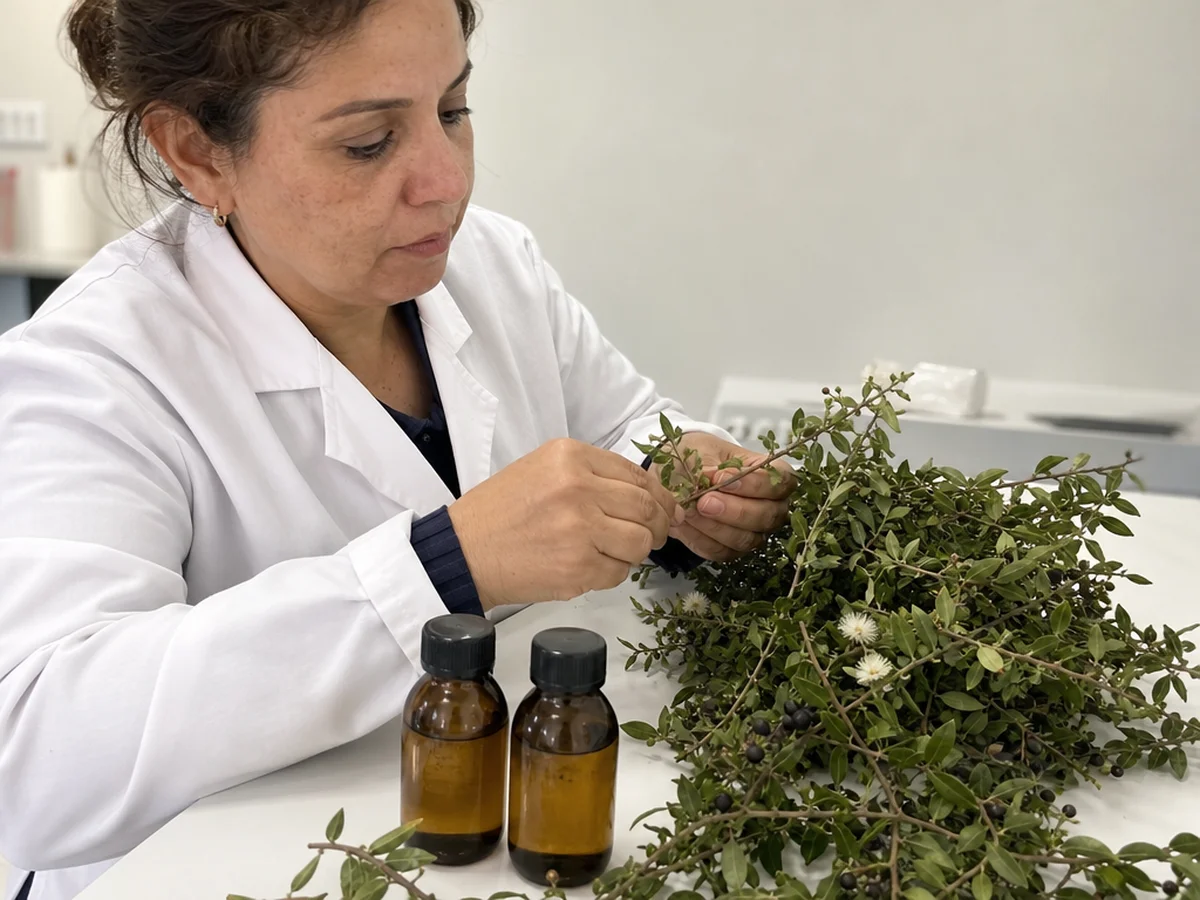
Cineole is the second reason. Tisserand's quoted rule is that oils with 40% or more 1,8-cineole should not be applied to the face of infants or children or inhaled by them. The Moroccan sample above sits over that line and the others under it, so a colour name is not a dependable guide to it. Methyl eugenol is the third reason: samples span 0.2% in the Corsican oil to 5.15% in the top Sardinian genotype, and IFRA's caps scale with it, as our safety post shows.
What our certificate tells you
The Certificate of Analysis we publish is for one batch. It lists steam distillation, the botanical name, and "Complies" against stated ranges for appearance, smell, relative density and refractive index. It does not report 1,8-cineole, myrtenyl acetate, linalool or methyl eugenol, so it cannot tell you where that batch falls on this spectrum. If you need constituent data for a formulation, a safety file or a label, ask us in writing through the contact page before ordering and read the numbers rather than the colour.
A little smelling exercise
If you ever have two myrtle oils on your bench, try them side by side. Dip one paper strip in each, label the strips in pencil, and smell them a minute apart. Jot down plain words: sharper or softer, leafy or sweet, cool or warm. Smell them again after ten minutes and note what stayed. It costs nothing, and you end up with your own vocabulary for what each oil does, which is worth more than a colour name on a listing. Keep those notes next to the lot number so you can compare the next bottle with the last.
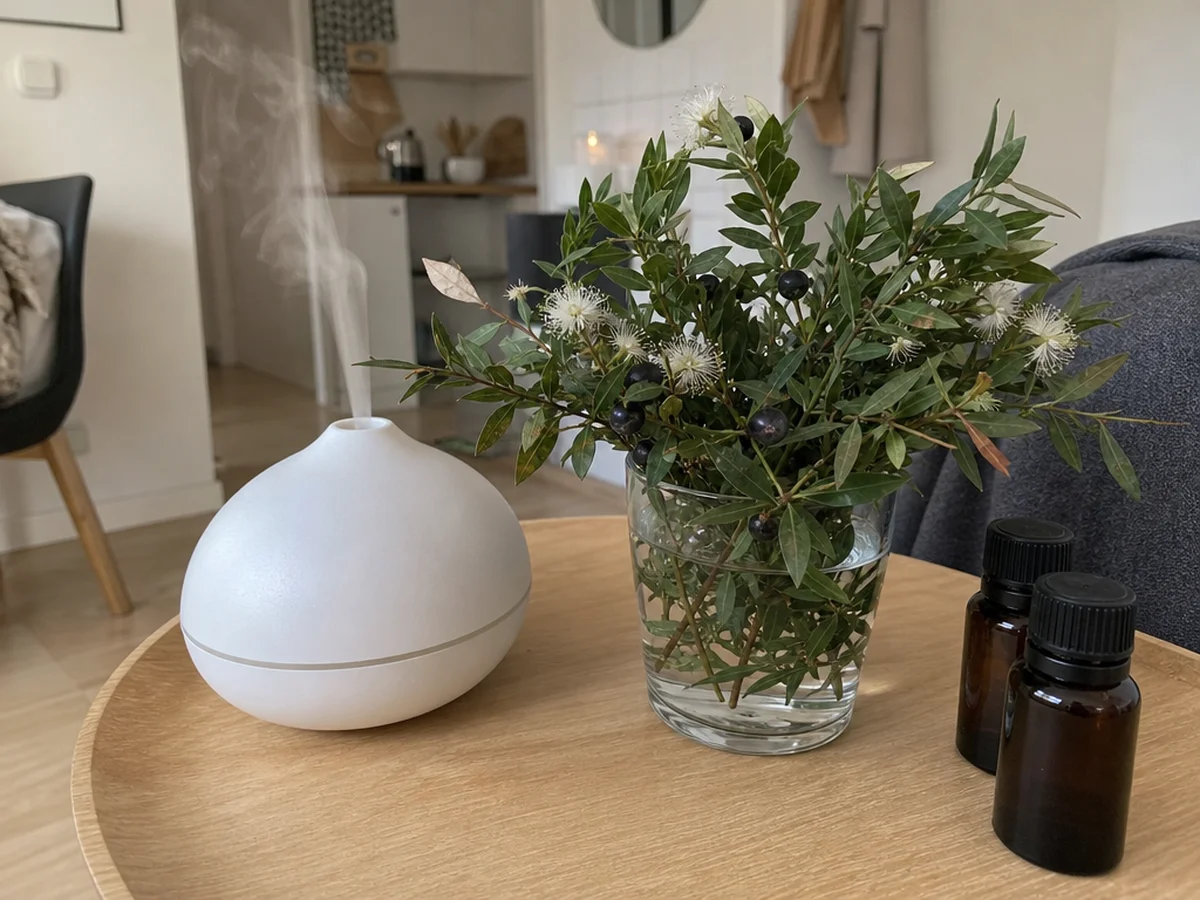
Do not worry if your words feel vague at first. "Greener" or "sweeter" is a perfectly good start, and after a few comparisons you will find the vocabulary sharpens on its own.
Neither type is better
A cineole-led oil and a myrtenyl-acetate-led oil are different materials with different jobs in a formula. Neither is adulterated just because it departs from a trade description. Where the spread bites is in repeat work. Two bottles both sold as "green myrtle" can smell and calculate differently, so a formula that works for one lot deserves its numbers checked against the next. Record the lot number and the report figures next to each formula, and a change in profile shows up on paper before it shows up in the finished product.
When you read a myrtle listing, treat "green" or "red" as an invitation to ask for 1,8-cineole, myrtenyl acetate, linalool and methyl eugenol, and treat a country as a hint rather than proof. Our guides to reading a label, GC-MS reports and origin go deeper, and the plant post introduces the shrub.
Myrtle Essential Oil
Myrtle Essential Oil from our own shop, in sizes from 0.5 oz to bulk.
From $16.99
Shop Now →Sources & Further Reading
- Hopewell Essential Oils, Myrtle (quotes Tisserand on green and red myrtle and lists a Moroccan lot). hopewelloils.com/myrtle.php
- Hardy et al., Quorum-Quenching Activity of Myrtus communis Corsican Essential Oil Against the Marine Bacterium Aliivibrio fischeri, Microorganisms, 2025. PMC12195544
- Et-tazy et al., Exploring synergistic insecticidal effects of binary mixtures of major compounds from six essential oils against Callosobruchus maculatus, Scientific Reports, 2025. PMC12044010
- Mohamadi et al., Chemical composition and antimicrobial activity of Myrtus communis essential oils from Algeria, Biodiversitas, 2021. smujo.id/biodiv/article/view/7327
- Usai et al., Chemotaxonomic Evaluation by Volatolomics Analysis of Fifty-Two Genotypes of Myrtus communis L., Plants, 2020. PMC7650784
- International Fragrance Association, IFRA Standards, 51st Amendment (methyl eugenol standard). ifra-standards-51st-amendment.pdf