Myrtle Oil Safety: Dilution, Patch Tests, Pets
Myrtle oil rewards a light hand. It is a concentrated botanical, and the habits that go with it are simple ones: dilute it, test it, cap it, and keep it where children and pets cannot reach it. Here is how we think about each, and why we would start lower than you might expect.
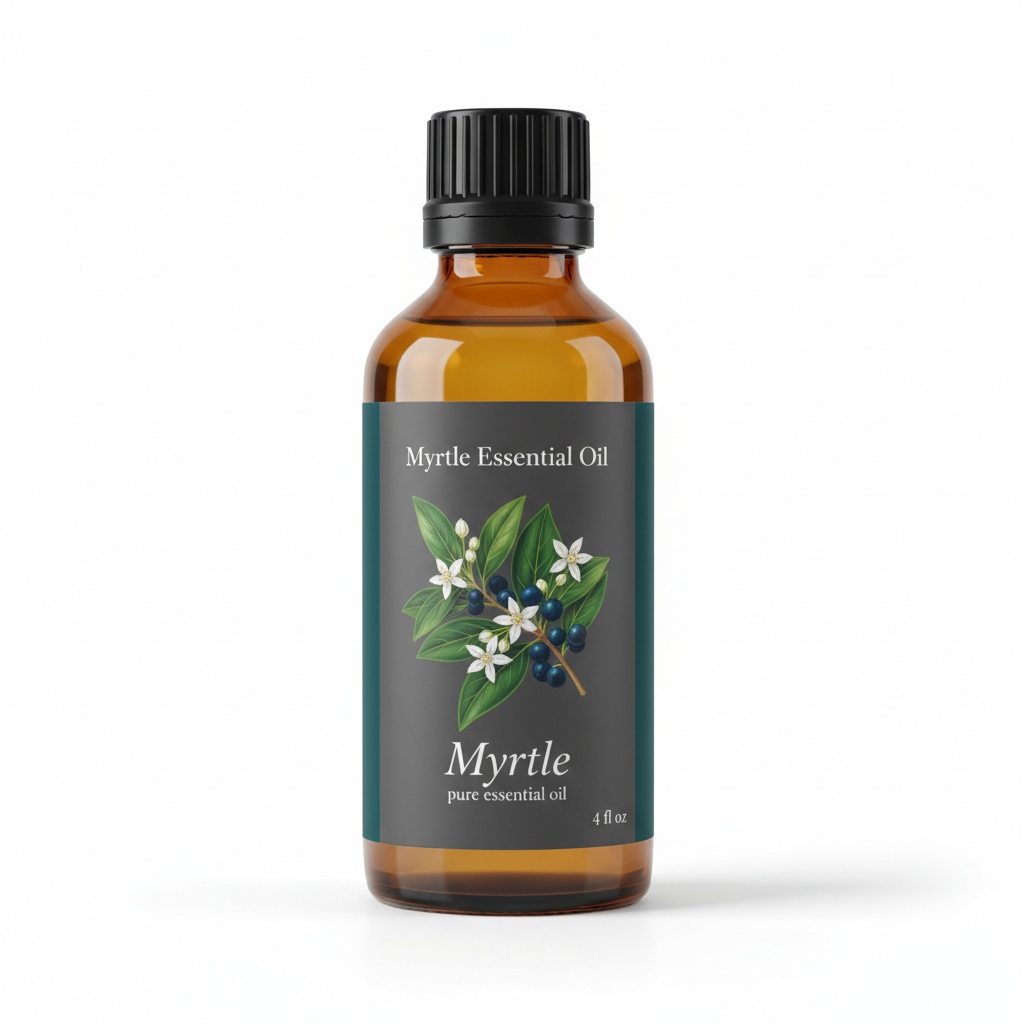
Myrtle Essential Oil
Our own Myrtle Essential Oil, in sizes from 0.5 oz to bulk.
From $16.99
Shop Now →Start low, then decide
Our dilution guidance for skin is 0.5% to 2% in a carrier oil, with a patch test first. In an ounce of carrier that works out to roughly 3 to 12 drops. We sell the oil neat, so the maths is yours, and our suggestion is to begin at the bottom of that range.
The reason is that outside authorities point lower at the top end. A supplier page quoting Tisserand and Young lists a maximum dermal use level of 1.9% for myrtle oil, which sits just under our 2% ceiling. The fragrance industry's IFRA standards go further, though in an indirect way. They have no entry for myrtle oil itself, but they cap methyl eugenol, a constituent myrtle oil can carry, by product type. For a body lotion or oil (Category 5A) the cap is 0.0015% of the finished product, and for a face moisturizer (5B) it is 0.00021%.
Divide a cap by the share of methyl eugenol in an oil and you get the most oil the product can hold. Published myrtle samples run from 0.2% in a Corsican leaf oil to a mean of 1.40% across 19 Algerian localities, so the answer swings widely. At 0.40%, a body oil tops out near 0.375% myrtle, and a face product near 0.05%. That is our arithmetic, and IFRA writes its standards for commercial products rather than home blends, but it shows why we say start low: in a carrier, 0.5% is about 3 drops per ounce, and many people will be happy with less. For anything on the face, go lower still.
The Certificate of Analysis we publish for one batch lists density, refractive index and appearance against stated ranges. If you need a constituent breakdown for your formulation, ask us in writing through the contact page before ordering. Our massage oil post turns the same arithmetic into a batch sheet, and the GC-MS reading guide shows what to look for in a report.
A patch test is a small, useful check
Put a little of your diluted blend on a small patch of skin and see how it feels over the next day. That tells you about this dilution on this skin, which is worth knowing. It does not tell you how the oil will behave at a higher strength or on your face, and it does not follow the bottle through its life.

That last point is about oxidation. A review of fragrance allergy describes how limonene and linalool, two common terpenes, form hydroperoxides when they meet air, and that these oxidized forms are the major allergens among them. Myrtle oil carries both terpenes (3.8% linalool and 8.7% limonene in the Corsican sample). So a patch test in month one says less about a bottle that has sat open in a warm cupboard for a year. Keep the cap on tight, store the bottle somewhere cool and dark, and replace it if the aroma turns sharp or flat. We put typical shelf life at 2 to 3 years, and the storage post covers the details.
The Tisserand Institute adds two plain rules: do not put undiluted oil on skin, and never drip it into the eyes, where it can cause a chemical burn. If you have eczema, a known fragrance allergy or asthma, a dermatologist or allergist is the right person to ask before you start.
Children and pets
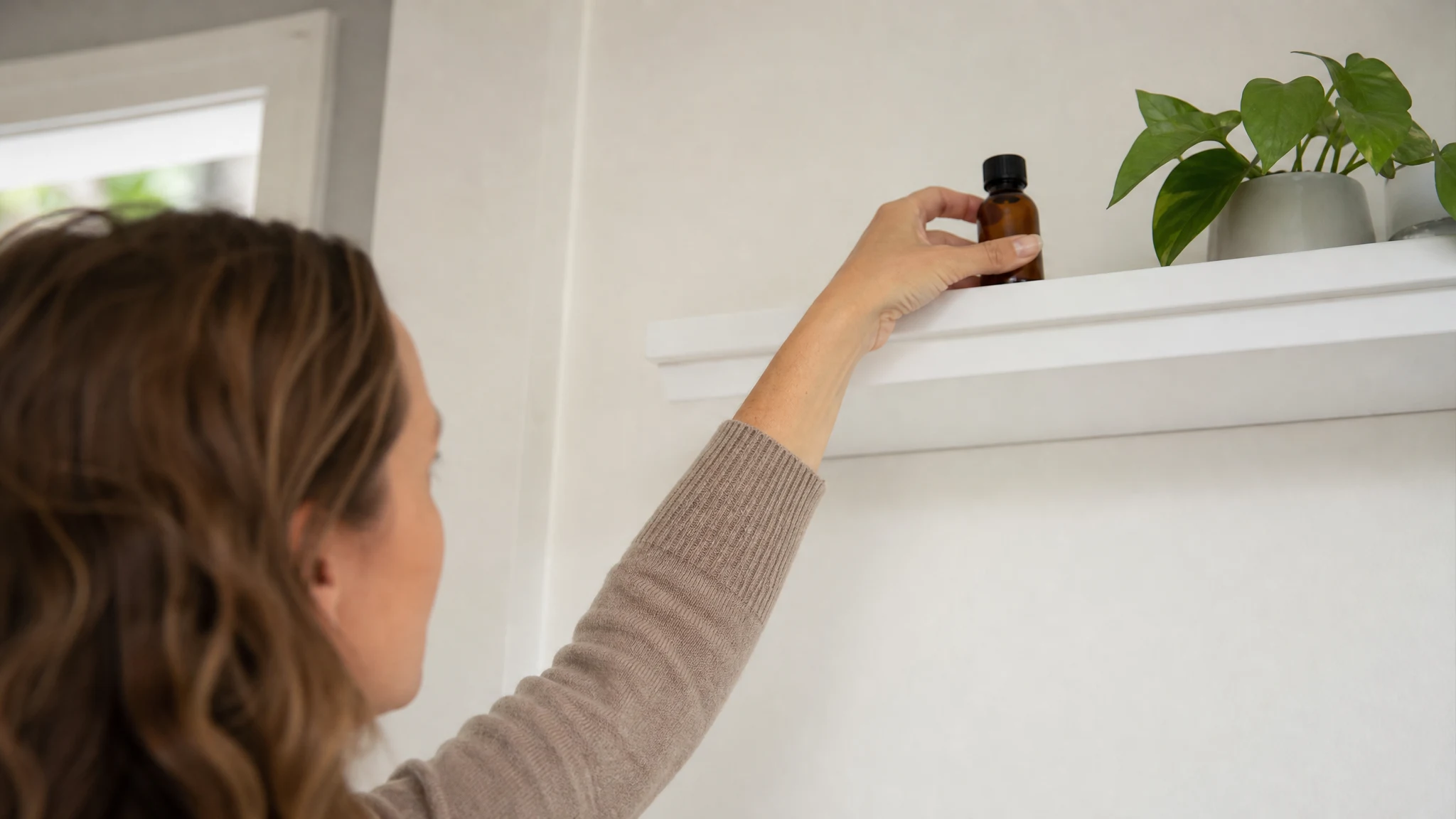
We keep myrtle oil away from children and pets, and the bottle belongs on a high shelf. The Tisserand Institute recommends child-proof caps and notes that they do not prevent every accident.
There is also a rule about chemistry. The same supplier page quotes Tisserand: any oil with 40% or more 1,8-cineole should not be applied to the face of infants or children, or inhaled by them. Published myrtle oils sit on both sides of that line: 42.22% in a Moroccan leaf oil, 28.8% in the Corsican one. A colour name like green or red will not place a bottle on that scale. In practice that means no myrtle on a child's face and no diffusing in a child's room. Questions about a child's skin or breathing go to a pediatrician. Our steam inhalation post covers the burn side of hot water separately.
For pets, the ASPCA says concentrated oils can harm dogs and cats that walk through them, get them on their coats or have them applied directly, and advises against applying essential oils to pets at all. It describes a short diffuser session in a closed room the pet cannot enter as unlikely to cause trouble, and suggests pets with breathing problems avoid diffusers, as should homes with birds. For people, Tisserand's diffusing rhythm is 30 to 60 minutes on and 30 to 60 minutes off, with some fresh air. None of these sources tests myrtle specifically, so we treat them as general rules for a pinene-and-cineole oil. If a pet seems unwell, call your veterinarian or the Animal Poison Control Center.
Pregnancy and swallowing
Our disclaimer asks anyone who is pregnant, nursing or managing a medical condition to talk with a physician first, and the Tisserand Institute says the same for pregnancy, epilepsy and asthma. What the published sources say is in our pregnancy post. Our oil is for external use only. If anyone swallows it, call poison control or a clinician. The ingestion post explains why.
One last practical tip: keep a small card inside the cupboard where the bottle lives, with the dilution you chose and the date you opened it. It takes seconds, and anyone else who opens the cupboard will know what is what.
Put together, the routine is short: read the label, write the date on the bottle, decide what you are making, work out the percentage on paper, patch test, and cap it tightly afterwards. Myrtle's fresh, clear aroma is easy to enjoy when the numbers stay small.
Myrtle Essential Oil
Myrtle Essential Oil from our own shop, in sizes from 0.5 oz to bulk.
From $16.99
Shop Now →Sources & Further Reading
- Hopewell Essential Oils, Myrtle (product page quoting Tisserand and Young on the 1.9% dermal maximum and the 1,8-cineole rule). hopewelloils.com/myrtle.php
- International Fragrance Association, IFRA Standards, 51st Amendment (methyl eugenol standard). ifra-standards-51st-amendment.pdf
- Hardy et al., Quorum-Quenching Activity of Myrtus communis Corsican Essential Oil Against the Marine Bacterium Aliivibrio fischeri, Microorganisms, 2025. PMC12195544
- Mohamadi et al., Chemical composition and antimicrobial activity of Myrtus communis essential oils from Algeria, Biodiversitas, 2021. smujo.id/biodiv/article/view/7327
- Et-tazy et al., Exploring synergistic insecticidal effects of binary mixtures of major compounds from six essential oils against Callosobruchus maculatus, Scientific Reports, 2025. PMC12044010
- Uter, Contact allergy to fragrances: current clinical and regulatory trends, Allergologie Select, 2017. PMC6040011
- Tisserand Institute, How to Use Essential Oils Safely. tisserandinstitute.org/safety/safety-guidelines
- ASPCA, The Essentials of Essential Oils Around Pets (June 23, 2022). aspca.org/news/essentials-essential-oils-around-pets