Myrtle or Rosemary Oil? Telling Two Green Scents Apart
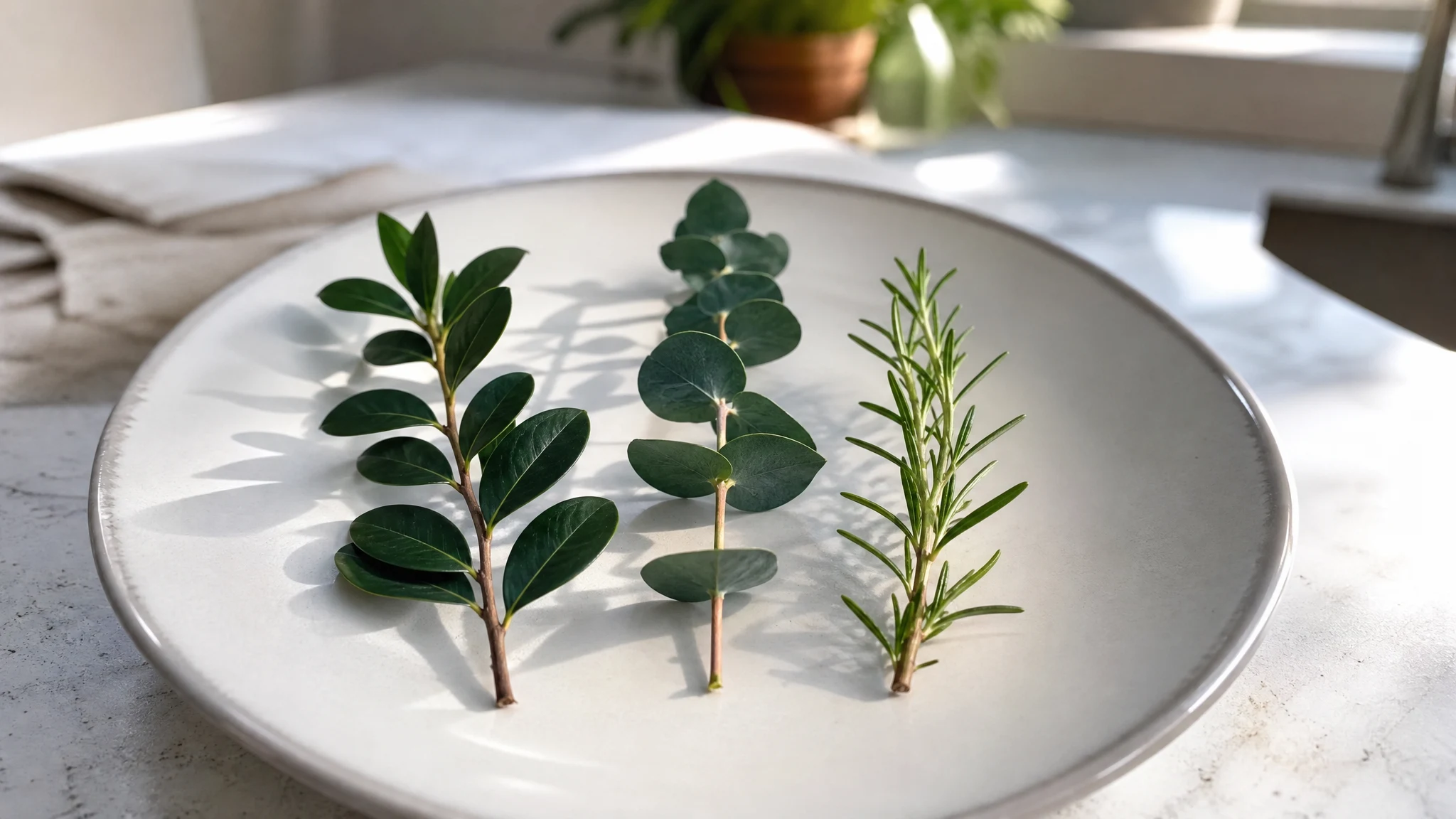
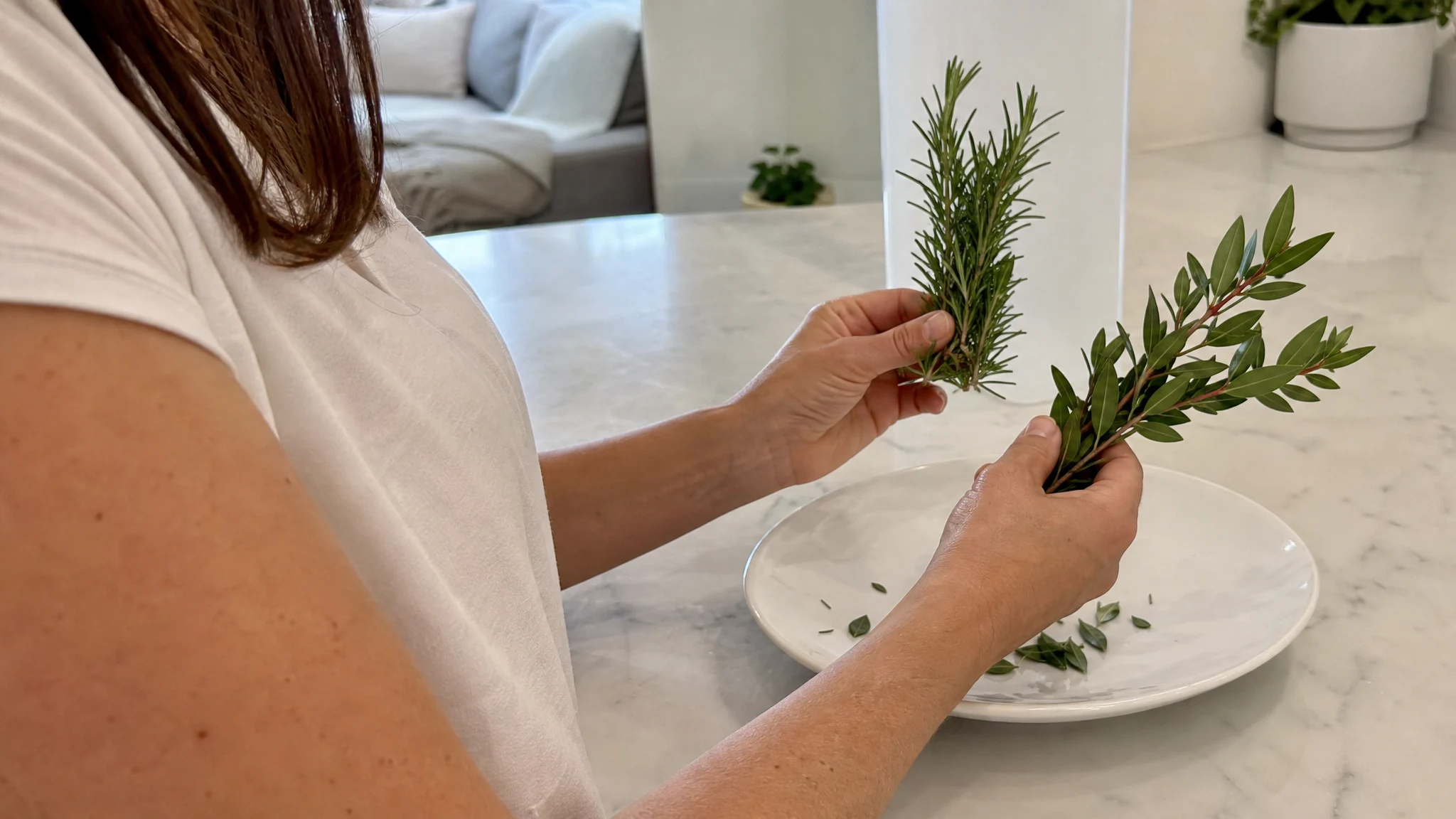
Rosemary and myrtle sit close together on the herbal shelf. Both smell green, both have a clean edge, and both turn up in blends meant to feel fresh and bright. Look a little closer and they part ways: rosemary tilts toward camphor and resin, while myrtle tilts toward something softer and faintly sweet. Here is how to tell them apart and how to use that in a blend.
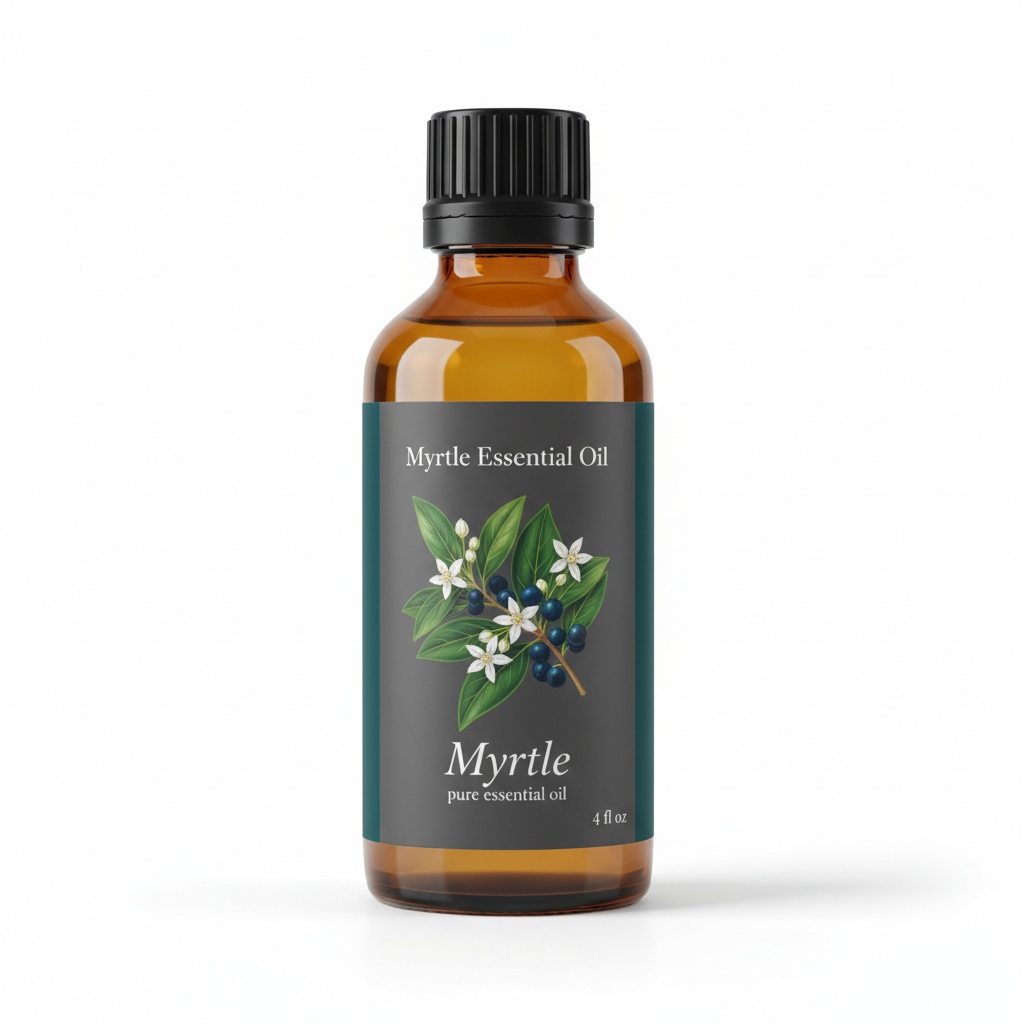
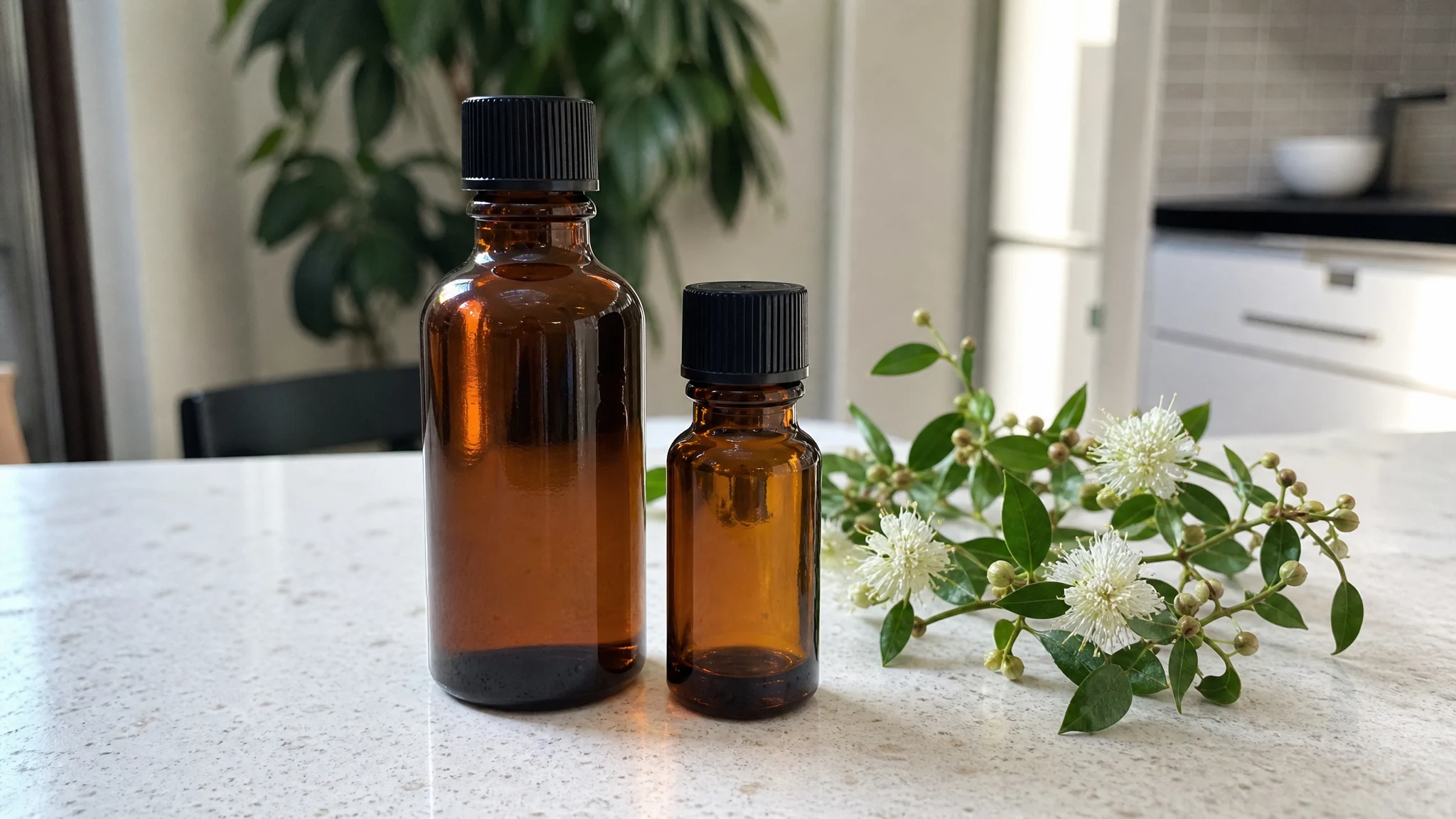
Myrtle Essential Oil
Our own Myrtle Essential Oil, in sizes from 0.5 oz to bulk.
From $16.99
Shop Now →If you have ever crushed a sprig of rosemary from the garden, you already know half of this story. The sharp green, slightly piney smell is the family trait the two oils share, and it is a good place to start when you open a bottle of myrtle for the first time.
What they have in common
The overlap is in two building blocks, alpha-pinene (the green, pine-like note) and 1,8-cineole (the cool note). Rosemary oils from six countries studied together were dominated by alpha-pinene at 13.5% to 37.7% and 1,8-cineole at 16.1% to 29.3% (Satyal et al., 2017). Myrtle leaf oils lead with the same two: across 19 Algerian populations the averages were 50.1% alpha-pinene and 22.27% cineole (Mohamadi et al., 2021). That is why the two read as relatives on a blotter, and why we list rosemary among the oils that sit well beside myrtle.
A practical habit while you compare: smell the oils in a well-ventilated room, give your nose a break between strips by sniffing the inside of your elbow or a plain cotton sleeve, and stop after a few strips. Noses tire quickly, and the third oil of the day rarely smells like itself.
Where rosemary goes its own way
Rosemary adds camphor, verbenone and borneol. In the six-country study, camphor ran from 0.7% to 7.0%, verbenone up to 16.9% and borneol up to 6.9%, and clustering with 72 literature compositions found at least five rosemary chemotypes. A 2025 month-by-month study in an arid Mediterranean region found camphor between 7.12% and 15.37% (Abbad et al., 2025). The practical consequence is that the word rosemary alone does not tell you the smell: a cineole-led oil is crisp and medicinal, and a camphor-richer one is warmer and more resinous. If you buy rosemary elsewhere, ask for the botanical name and the lot's main components.
Where myrtle goes its own way
Myrtle brings esters and linalool instead. In a study of 52 Sardinian genotypes grown in one field, linalool reached about 24% in some plants and myrtenyl acetate about 28% in others, while alpha-pinene swung from roughly 13.8% to 46.5% (Usai et al., 2020). Linalool and myrtenyl acetate are sweeter and more floral, which fits how we describe our oil: fresh, clear and gently floral, with a soft eucalyptus-like coolness and faintly honeyed facets. Myrtle varies as much as rosemary does from plant to plant, so for a precise formula the same advice applies: look at the lot's own numbers.
How they compare on a blotter
Dip two paper strips, one in each oil, and hold them a few inches from your nose. Rosemary wakes the nose quickly with a brisk, resinous snap. Myrtle is slower: green first, then a soft floral turn with a hint of honey. If you like to work the way a perfumer does, come back to the strips after a few minutes and write down what each one has become.
Choosing, and blending
- For a crisp, resinous, study-room kind of scent, rosemary is the more direct choice, and you can find it at an aromatherapy or craft supplier since we sell myrtle only.
- For something green with a softer floral heart, myrtle is the one. Our guide to myrtle's scent profile goes into more detail.
- For a blend, the pair works. We list lemon, lavender, rosemary, neroli and clary sage as partners for myrtle, and our pairing guide shows how to build around it.
A blending idea to start with
If you want to try the two together, begin with myrtle as the main note and add rosemary as an accent, a drop at a time on a blotter before anything goes into a bottle. Rosemary tends to dominate, so a little goes a long way. Write down the ratio so you can repeat a combination you like.
Do not treat them as swaps
Because they overlap in scent, people sometimes swap one for the other, and the result is a different blend rather than a copy. Their handling guidance differs too. For myrtle, our dilution guidance is 0.5% to 2% in a carrier with a patch test first, and since a supplier page quoting Tisserand and Young gives 1.9% as the maximum dermal level (Myrtle - Hopewell Essential Oils), we suggest starting at 0.5%. Rosemary has its own limits, so use the ones from whoever supplies it. For anyone with epilepsy, or anyone unsure about an oil's camphor content, a neurologist or pharmacist is the right person to ask before use.
We think this is one of the nicest herbal pairings on the shelf, and the fun of it is that you steer the blend by ear.
For an easy comparison of the neighbours, see how myrtle sits beside tea tree and eucalyptus as well. Rosemary and myrtle make a good pair precisely because they are not the same oil.
Myrtle Essential Oil
Myrtle Essential Oil from our own shop, in sizes from 0.5 oz to bulk.
From $16.99
Shop Now →Sources & Further Reading
- Satyal P, Jones TH, Lopez EM, et al., 2017. Chemotypic Characterization and Biological Activity of Rosmarinus officinalis. Foods. PMC5368539
- Abbad I, Soulaimani B, El Haki M, et al., 2025. Phytochemical composition and synergistic antimicrobial effects of Rosmarinus officinalis essential oils during flowering in an arid mediterranean region. AIMS Microbiology. PMC12783073
- Usai M, Marchetti M, Culeddu N, et al., 2020. Chemotaxonomic Evaluation by Volatolomics Analysis of Fifty-Two Genotypes of Myrtus communis L. Plants. PMC7650784
- Mohamadi Y, Lograda T, Ramdani M, Figueredo G, Chalard P, 2021. Chemical composition and antimicrobial activity of Myrtus communis essential oils from Algeria. Biodiversitas 22(2). smujo.id
- Hopewell Essential Oils. Myrtle - Hopewell Essential Oils. hopewelloils.com