How to Read a Myrtle Oil GC-MS Report
A GC-MS report looks wonderfully authoritative: a neat table of compound names with percentages beside them. What it really shows is a ranking of peaks, and a few reading habits make the difference between being reassured by a table and being informed by it. With myrtle oil, where two of the smallest lines on the page decide how you dilute, those habits pay off.
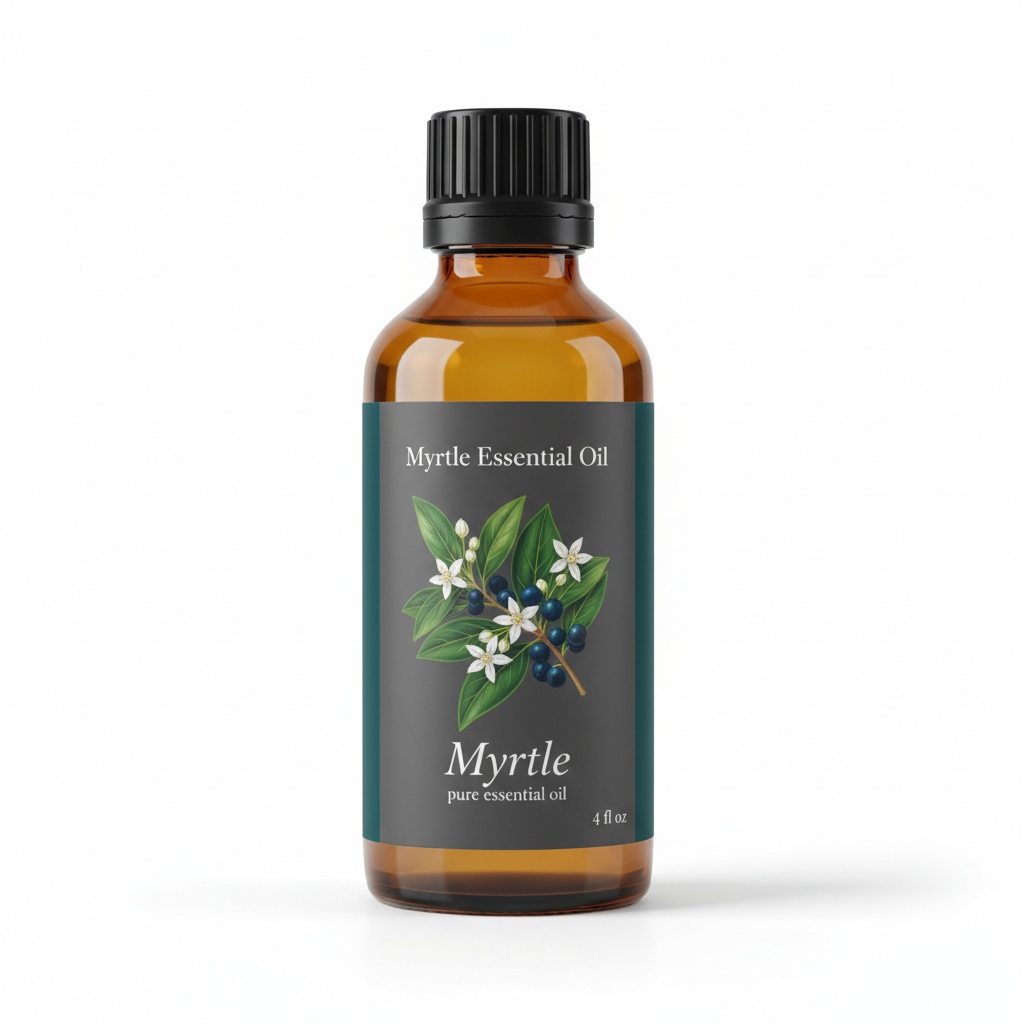
Myrtle Essential Oil
Our own Myrtle Essential Oil, in sizes from 0.5 oz to bulk.
From $16.99
Shop Now →Start at the top of the page
Before you look at a single percentage, find the lot number (it should match your bottle), the date, the laboratory, and the column and method used. A table without those details is a claim rather than a measurement. It also helps to know what kind of document you hold. A certificate of analysis is a supplier's summary of the checks made on a batch, anywhere from a few "Complies" lines to a full chromatogram. GC-MS is one specific test within it.
The Certificate of Analysis we publish for one batch (MRTAICUNUNC001A) lists the botanical name, leaf as the part used, steam distillation, a best-by date, and density and refractive index at 20 C marked "Complies" against stated ranges. It does not include GC-MS. If you need constituent figures, ask us in writing through the contact page before ordering, and get the reply in writing too. Our label-reading guide covers the questions that stop short of GC-MS.
Names need a second check
A mass spectrometer identifies molecules by how they break apart, and look-alike molecules break apart alike. Laboratories therefore add a retention index, a number that says when a compound leaves the column, scaled so values compare across instruments. A National Institute of Standards and Technology evaluation of 505 essential-oil components notes that combining retention data with mass spectrometry gives "a nearly unambiguous identification of isomers, which is difficult using mass spectra alone" (Babushok, Linstrom and Zenkevich, 2011).
Myrtle gives a lovely example. Limonene and 1,8-cineole, both common in the oil, come off a standard slightly polar column at 1029.5 and 1031.8, practically on top of each other. On a polar column the same pair sits at 1198.2 and 1211.1. That is why a report should say which column it used, and why a 1,8-cineole figure with no retention index is less reassuring than it looks.
Percent area is not percent weight
The percentages in most reports are shares of total peak area, and detectors respond differently to different molecules, so equal areas are not equal amounts. An editorial in Flavour and Fragrance Journal says that with mass-spectrometer detection area percentages are not repeatable over time, and that with a flame ionization detector they are inaccurate and discouraged except for comparing samples run under identical conditions (Chaintreau, Bicchi and Rubiolo, 2019). In practice, read a plain area table as a ranking with approximate proportions, and do not compare a figure from one laboratory's report with another's as though both were exact.
What a myrtle report tends to show
Alpha-pinene often leads, with 1,8-cineole, linalool, limonene and sometimes myrtenyl acetate behind it, and the amounts swing a lot. Among 52 Sardinian genotypes grown in one field, 1,8-cineole ran from about 1% to 27% (Usai et al., 2020). Across 19 Algerian localities the authors identified six chemotypes (Mohamadi et al., 2021). A report with 1,8-cineole at 10% or at 25% is therefore unremarkable. What deserves a second look is a table that has 100% of just two compounds and nothing else.
The small lines that move your dilution
Methyl eugenol and estragole are minor in percentage and large in consequence. IFRA limits both in finished products and counts them wherever they arrive, natural oils included. For body lotions and creams (category 5A) the limits are 0.0015% methyl eugenol and 0.0022% estragole (IFRA Standards, 51st Amendment). Divide the limit by the compound's share of the oil and you have the most oil the product can contain. Our arithmetic: at 0.2% methyl eugenol that is up to 0.75% oil, and at the Algerian average of 1.40% it is about 0.1%.
Our own dilution guidance is 0.5% to 2% in a carrier oil. IFRA's limits govern commercial products, so applying them to a home blend is our reading, not a rule, but they explain why we begin at 0.5% and suggest going lower for anything left on skin until a report in hand shows the two compounds by name. The safety basics post has the household side.
Keep the report with the bottle
A report is only useful if you can find it again. File each one under the lot number, clip it to a note of the date the bottle arrived, and write the same lot number on the bottle itself. When a new bottle comes, lay the two reports side by side and see what moved. It is a dull little habit, but it is the one that makes a formula repeatable, and it turns a stack of PDFs into something you can actually use.
What GC-MS cannot tell you
A clean report does not prove origin, harvest method, freshness or organic status, and it says nothing about how an oil smells. It is one tool among several, as our quality-checks post explains. When you ask a supplier for one, ask for the lot number and date, the laboratory, the column and method, retention indices, the quantification method, and methyl eugenol and estragole by name.
Armed with those, a table of peaks turns back into what it should be, a useful portrait of the oil in your hand.
Myrtle Essential Oil
Myrtle Essential Oil from our own shop, in sizes from 0.5 oz to bulk.
From $16.99
Shop Now →Sources & Further Reading
- Babushok VI, Linstrom PJ, Zenkevich IG, 2011. Retention Indices for Frequently Reported Compounds of Plant Essential Oils. J Phys Chem Ref Data. NIST
- Chaintreau A, Bicchi C, Rubiolo P, 2019. Quantifying the constituents of flavours, fragrances and essential oils. Flavour Fragr J. Open-access copy
- Usai M et al., 2020. Chemotaxonomic Evaluation by Volatolomics Analysis of Fifty-Two Genotypes of Myrtus communis L. Plants. PMC7650784
- Mohamadi Y et al., 2021. Chemical composition and antimicrobial activity of Myrtus communis essential oils from Algeria. Biodiversitas. smujo.id
- IFRA Standards, 51st Amendment (estragole and methyl eugenol standards). IFRA