Myrtle Oil and Sleep: What the Research Shows
A fresh, clear scent in the bedroom is a lovely thing, and it is natural to wonder whether an essential oil belongs in a wind-down routine. For myrtle, the straight answer is that it gives you a pleasant aroma and that nobody has yet studied it for sleep in people. Here is what the research does cover, so you can enjoy the scent with clear eyes.
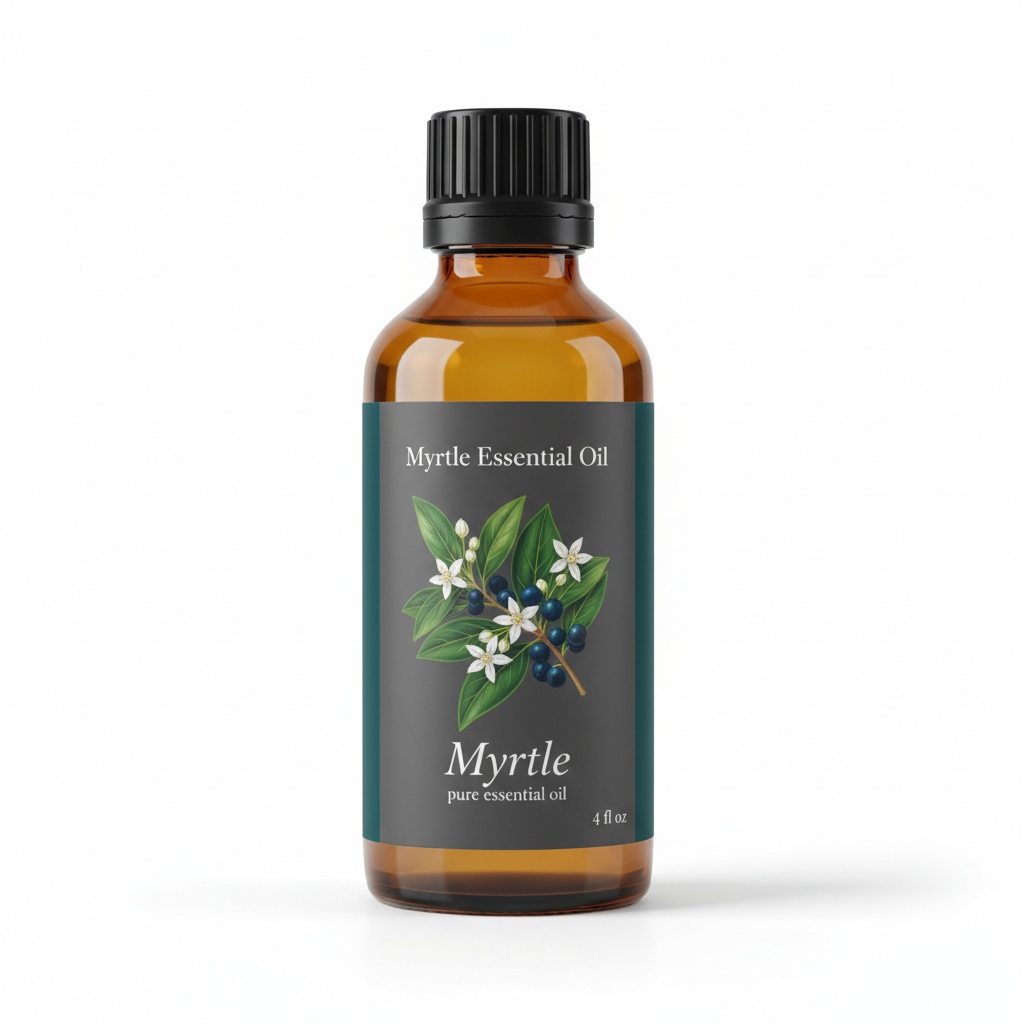
Myrtle Essential Oil
Our own Myrtle Essential Oil, in sizes from 0.5 oz to bulk.
From $16.99
Shop Now →What has been studied in myrtle itself
A Europe PMC search on 28 October 2026 for myrtle oil together with sleep terms found no trial of myrtle oil inhaled, diffused or applied for sleep in people. The one study that touches the subject gave myrtle leaf oil by mouth to mice, at 600 to 1,000 mg per kg. The oil did not put the mice to sleep on its own, but it lengthened the sleep induced by a sedative drug, and the mice did worse on coordination tests. The authors read that as depressant activity on the central nervous system (Birhanie et al., 2016).
That result is about swallowing large doses, which nobody should do with an essential oil, and about a drug interaction in animals. It is a signal for toxicologists, not a finding about a scented room. Our myrtle oil is for external use only.
What the wider scent research looks like
Aromatherapy reviews do pool favourable results for sleep. A 2015 meta-analysis of 12 trials found aromatherapy improved sleep quality, with inhalation doing better than massage (Hwang and Shin, 2015), and a 2021 analysis of 34 studies of inhaled aroma found that lavender had the largest effect among the single oils (Cheong et al., 2021). Neither abstract mentions myrtle. Results like these are mostly self-reported, which is worth remembering with any scent, because what we expect from a smell is part of what we report.
Our favourite detail comes from a trial of 79 college students with sleep complaints. Everyone practised good sleep habits and wore a small inhalation patch on their chest at night, and half of the patches held 55 microlitres of lavender oil, roughly a drop. Both groups reported better sleep quality, and the lavender group improved more, with the gain still there two weeks later (Lillehei et al., 2015). Lavender is a different plant with different chemistry, so we would not read that result onto myrtle. It does show how much the habits around the scent were doing.
What sleep specialists put first
For long-running insomnia, the American College of Physicians recommends cognitive behavioral therapy for insomnia as the first treatment for adults, a strong recommendation, and says medication should come after that as a shared decision with a clinician (Qaseem et al., 2016). The NHS lists the everyday culprits as stress, noise, a room that is too hot or cold, and alcohol, caffeine or nicotine, and suggests seeing a GP if changing your sleeping habits has not helped, if trouble sleeping has lasted for months, or if it makes daily life hard to cope with (NHS). A physician or sleep specialist is the right person for those questions.
Enjoying the aroma sensibly
If you simply like the smell, there are easy ways to enjoy it without making it into a project. Open the bottle and take a slow sniff, or put a drop on a paper strip and leave it on a shelf away from skin and fabric. If you diffuse, start with the smallest amount your diffuser calls for and open a window. Switch it off when the scent has done its work, and keep the bottle capped and out of reach of children and pets.
Questions to ask of any sleep claim
- Which oil was used, and is it the same plant as yours?
- Was it inhaled, applied or swallowed, and in what amount?
- Who took part, and how was sleep measured?
- Does the person making the claim have something to sell?
These four questions do not require any special knowledge, and they filter out most of the noise.
Why we talk about scent and nothing more
We sell myrtle essential oil as an external cosmetic oil. The FDA gives a fragrance marketed with aromatherapy claims such as helping you sleep as an example of a product that meets the legal definition of a drug because of its intended use (FDA). That is why you will not find a bedtime blend from us. What we can tell you about is the aroma itself, which is fresh, clear and gently floral with a cool edge, and how to enjoy it sensibly in a room.
If you diffuse it, keep the sessions short, keep the room ventilated and keep the bottle where children and pets cannot reach it. Our home-use guide covers the practical details, the scent profile describes what to expect when you open the bottle, and the safety basics cover the household rules.
If you love myrtle's clean green scent while you tidy up the evening or read a chapter, that is reason enough to keep a bottle close.
Myrtle Essential Oil
Myrtle Essential Oil from our own shop, in sizes from 0.5 oz to bulk.
From $16.99
Shop Now →Sources & Further Reading
- Birhanie MW, Walle B, Rebba K, 2016. Hypnotic effect of the essential oil from the leaves of Myrtus communis on mice. Nat Sci Sleep. Europe PMC
- Hwang E, Shin S, 2015. The effects of aromatherapy on sleep improvement: a systematic literature review and meta-analysis. J Altern Complement Med. Europe PMC
- Cheong MJ et al., 2021. A systematic literature review and meta-analysis of the clinical effects of aroma inhalation therapy on sleep problems. Medicine (Baltimore). Europe PMC
- Lillehei AS et al., 2015. Effect of Inhaled Lavender and Sleep Hygiene on Self-Reported Sleep Issues: A Randomized Controlled Trial. J Altern Complement Med. Europe PMC
- Qaseem A et al., 2016. Management of Chronic Insomnia Disorder in Adults: A Clinical Practice Guideline From the American College of Physicians. Ann Intern Med. Europe PMC
- NHS. Insomnia. nhs.uk
- FDA. Is It a Cosmetic, a Drug, or Both? (Or Is It Soap?). fda.gov