Myrtle Oil in Hair Oil: How Little You Need
A little fragrant oil in a hair oil or brush-through blend is a lovely idea, and myrtle's fresh, clear, gently floral aroma suits it. The one thing worth settling before you pour is how much. A scalp is a large, leave-on area you use again and again, and that changes the arithmetic from what you would use for a spot of body oil.
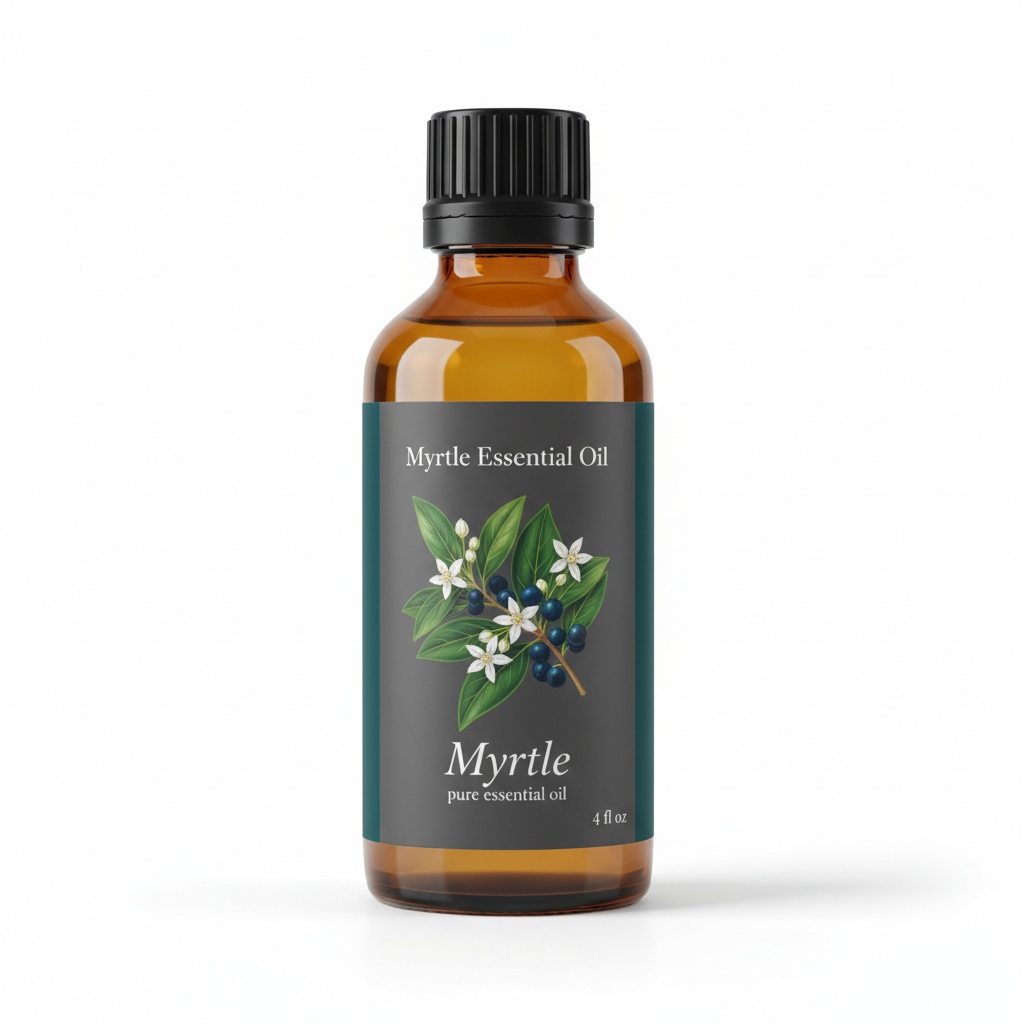
Myrtle Essential Oil
Our own Myrtle Essential Oil, in sizes from 0.5 oz to bulk.
From $16.99
Shop Now →What we do and do not say about myrtle and hair
We sell myrtle oil as an aromatic cosmetic oil and make no claims about what it does for hair or scalp. The studies people cite for essential oils and hair concern other plants, and we found none that tested myrtle essential oil on a head. What we can do is help with the maths of scenting a hair product, because that part has real published numbers behind it. If you are worried about hair thinning, shedding or flaking, the American Academy of Dermatology says effective treatment begins with finding the cause, and recommends a board-certified dermatologist for an accurate diagnosis. A scented oil cannot sort the possibilities apart.
How much fits in a hair oil
Our dilution guidance for skin is 0.5% to 2% in a carrier oil, and a supplier page quoting Tisserand and Young lists 1.9% as a maximum dermal level for myrtle. Those are general skin figures. Hair products have their own, much tighter benchmark. IFRA's standards cap methyl eugenol, a constituent myrtle oil can carry, at 0.00042% of the finished product for both rinse-off (Category 7A) and leave-on (7B) hair products. Dividing the cap by the share of methyl eugenol in the oil gives the most myrtle the product can hold. Published samples run from 0.2% in a Corsican leaf oil to 0.40% in one supplier's GC/MS lot to a mean of 1.40% across 19 Algerian localities:
| Methyl eugenol in the oil | Max myrtle in the product | In 100 g of carrier oil |
|---|---|---|
| 0.2% | 0.21% | about 0.21 g, nearly 5 drops |
| 0.40% | 0.105% | about 0.1 g, roughly 2 drops |
| 1.40% | 0.03% | about 0.03 g, under 1 drop |
Drops here assume about 0.045 g each, which is the rough convention of 20 drops per milliliter at about 0.9 g/ml; droppers vary, so weighing is better. Compare that with our 0.5% to 2% skin range, which in 100 g of hair oil would be 0.5 g to 2 g, about 11 to 44 drops. That is many times over the hair-product benchmark at every methyl eugenol figure in the table.
IFRA writes its standards for commercial products, and a person mixing at home is not bound by them. They are still the most specific published limit for this oil's chemistry. So here is our suggestion, as reasoning from those numbers: for a leave-on scalp or hair oil, use a drop or two per 100 g of carrier, and no more than that unless you hold a constituent report that supports it. Our 0.5% to 2% range is a general skin figure, and we would not apply it to a scalp.
The Certificate of Analysis we publish covers one batch and lists density and refractive index against stated ranges, so it does not print a methyl eugenol figure. If you want one for your formulation, ask us in writing through the contact page before ordering. The GC-MS reading guide shows what to look for in a report.
Making a hair oil feel good to use
Scent is only half the experience of a hair oil. The other half is how it feels in your hands. A light carrier spreads quickly, and warming a few drops between your palms before you smooth it over the ends of your hair gives a more even finish than pouring straight onto your head. Go slowly the first few times, since it is much easier to add a little more oil than to take it away.
Because so little myrtle goes into a blend, the scent will be soft, more a whisper of green than a fragrance cloud. That is part of its charm in a hair product: you notice it when you lean in or run a hand through, not from across the room.
Practical habits for a scalp blend
Patch test the diluted blend on a small area first, keep it clear of eyes, and store it capped, cool and dark. Choosing a light carrier suits a hair product, and our carrier oil comparison goes through the options, which you will find at a craft shop, pharmacy or grocery. Our myrtle versus rosemary post is worth a read if rosemary is the oil you were originally considering. The safety basics gather the rest of the cautions, and the skin post covers dilution beyond the scalp.
Mixing small, mixing often
Our suggestion for a first hair oil is to make a small bottle, label it with the date and the number of drops, and use it up before you make another. That way you can adjust the next batch by a single drop and you never have a large bottle of scented oil ageing on the shelf. A tidy note on the label, such as "2 drops in 100 g", is also a gift to future you when you want to repeat a blend you liked.
A fresh, green scent in a light oil can be a small daily pleasure, and a very small amount of myrtle is all it takes.
Myrtle Essential Oil
Myrtle Essential Oil from our own shop, in sizes from 0.5 oz to bulk.
From $16.99
Shop Now →Sources & Further Reading
- International Fragrance Association, IFRA Standards, 51st Amendment (methyl eugenol standard). ifra-standards-51st-amendment.pdf
- Hardy et al., Quorum-Quenching Activity of Myrtus communis Corsican Essential Oil Against the Marine Bacterium Aliivibrio fischeri, Microorganisms, 2025. PMC12195544
- Mohamadi et al., Chemical composition and antimicrobial activity of Myrtus communis essential oils from Algeria, Biodiversitas, 2021. smujo.id/biodiv/article/view/7327
- Hopewell Essential Oils, Myrtle (product page with a GC/MS lot and Tisserand and Young's 1.9% maximum). hopewelloils.com/myrtle.php
- American Academy of Dermatology, Hair loss: Diagnosis and treatment. aad.org