Myrtle Oil Research: What Studies Actually Cover
Ask what science has learned about myrtle oil and the answer may surprise you: mostly chemistry. Myrtle is one of the most carefully analysed shrubs of the Mediterranean, and the finding that keeps coming back is that no two myrtle oils are quite alike.
Myrtle Essential Oil
Our own Myrtle Essential Oil, in sizes from 0.5 oz to bulk.
From $16.99
Shop Now →A shrub with many faces
The cleanest evidence comes from a study that took the guesswork out of "where it grew". Researchers planted 52 myrtle genotypes in a single Sardinian field, distilled the leaves and ran each oil through GC-MS. Same soil, same climate, and still alpha-pinene ranged from about 14% to 47% and 1,8-cineole from about 1% to 27% (Usai et al., 2020). Genetics matter as well as place. A survey of wild plants from 19 Algerian coastal localities found six chemotypes, and myrtenyl acetate showed up at roughly 11% to 21% in just four of the populations (Mohamadi et al., 2021).
What that means in practice is that "myrtle oil" names a family of oils, and the aroma and the minor constituents can differ from one to the next. It is the reason we talk about composition as a question to ask, and why our GC-MS reading guide and label guide exist. The Certificate of Analysis we publish for one batch lists density and refractive index against stated ranges and does not list constituents, so if composition matters to you, ask us in writing through the contact page before ordering.
What happens in a laboratory dish
The next biggest group of papers tests oils against microbes or cultured cells. One Algerian study examined two leaf oils, found them most active against a yeast and three skin fungi, and measured that both lowered nitric oxide in stimulated mouse immune cells without reducing the cells' viability at concentrations up to 0.64 mg/mL (Bouzabata et al., 2015).
Results like these tell chemists that an oil is biologically active in a controlled setting, which is a great way to begin a question. They do not tell us what a scented room or a diluted body oil does, and we draw no conclusions of that kind.
Plain-language summaries of a paper are a good place to begin, as long as you follow the link to the source afterwards. Whenever we cite a study, the link is there so you can check what it really says.
When people are involved
Human studies that mention myrtle fall into two groups, and neither is about the plain oil. The first is a blend. In a 2024 trial in four dental practices, 486 patients had scents vaporised, and one of those scents was a blend of eight oils that included a 1,8-cineole type of Myrtus communis. Patients' anxiety scores were slightly lower in the scented groups overall, and with eight oils in one scent the design cannot say anything about myrtle on its own (Czakert et al., 2024).
The second is myrtol, a medicinal capsule distilled from several oils. It is easy to confuse with myrtle oil, and we untangle the two names in a separate post on myrtol and myrtle oil.
Meeting the chemistry with your nose
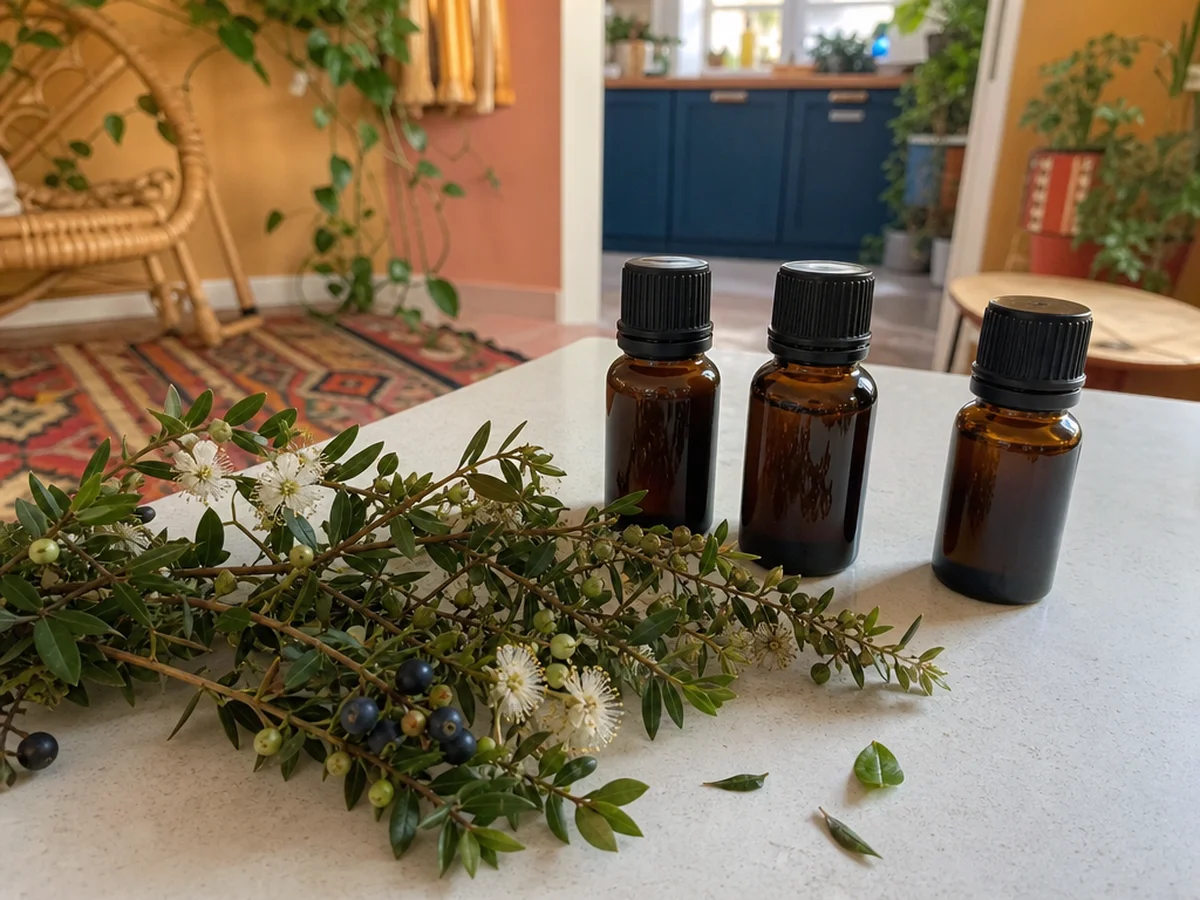
The nice thing about all those chemistry papers is that you can connect them to something you can actually smell. Open the bottle and notice the cool, clear opening, then the soft, faintly honeyed side. Those are the aromas, in plain words, that the tables of percentages are describing. You do not need to know the names to enjoy the difference between one myrtle and the next.
Reading a study like a curious friend
You do not need a science background to get something out of a paper. Look first at what the researchers actually put in the dish: a leaf oil, a berry extract, a capsule? Then at what it was tried on: cells, mice or people? A study of one thing tells you about that one thing, and that is why we are careful about what we claim. When a headline sounds exciting, a few minutes with the summary often shows how narrow the question was.
How we read all of this
The FDA decides how an aromatherapy product is regulated mainly by its intended use: a fragrance meant to make you smell good or enjoy a room is a cosmetic, while claims to treat health problems or change how the body works move a product into drug territory (FDA). We sell myrtle oil for its aroma, as an external cosmetic oil, and we describe it that way: fresh, clear and gently floral, with a soft cool edge. The studies above enrich the picture of the plant and its chemistry, and we use them for that.
If you would like to meet the shrub itself, our plant guide is the place to start, and the scent profile describes what to expect from the bottle.
What we hope you take from it
If you take one thing from this post, let it be curiosity. Myrtle has a long history in gardens, kitchens and weddings, and it keeps surprising the people who study it. Smell the bottle, read the label, and enjoy the plant for what it is. The next time you see a bold claim about any essential oil, you will know which questions to ask.
Myrtle's best-documented talent is variety, and that is part of what makes it such a rewarding oil to get to know.
Myrtle Essential Oil
Myrtle Essential Oil from our own shop, in sizes from 0.5 oz to bulk.
From $16.99
Shop Now →Sources & Further Reading
- Usai M et al., 2020. Chemotaxonomic Evaluation by Volatolomics Analysis of Fifty-Two Genotypes of Myrtus communis L. Plants. PMC7650784
- Mohamadi Y et al., 2021. Chemical composition and antimicrobial activity of Myrtus communis essential oils from Algeria. Biodiversitas. smujo.id
- Bouzabata A et al., 2015. Myrtus communis L. as source of a bioactive and safe essential oil. Food Chem Toxicol. PubMed
- Czakert J et al., 2024. Scenting serenity: influence of essential-oil vaporization on dental anxiety - a cluster-randomized, controlled, single-blinded study (AROMA_dent). Sci Rep. PubMed
- FDA. Aromatherapy. fda.gov