Myrtle Oil in Summer: Storing and Using It in Heat
Myrtle has one of those scents that seems made for July: fresh, clear and gently floral, with a soft eucalyptus-like coolness. It is also an oil that rewards a little care when the weather turns hot, because a sunny windowsill, an open porch door and a pile of summer products on your skin all change how you handle it. None of it is complicated, and most of it comes down to a few easy habits.
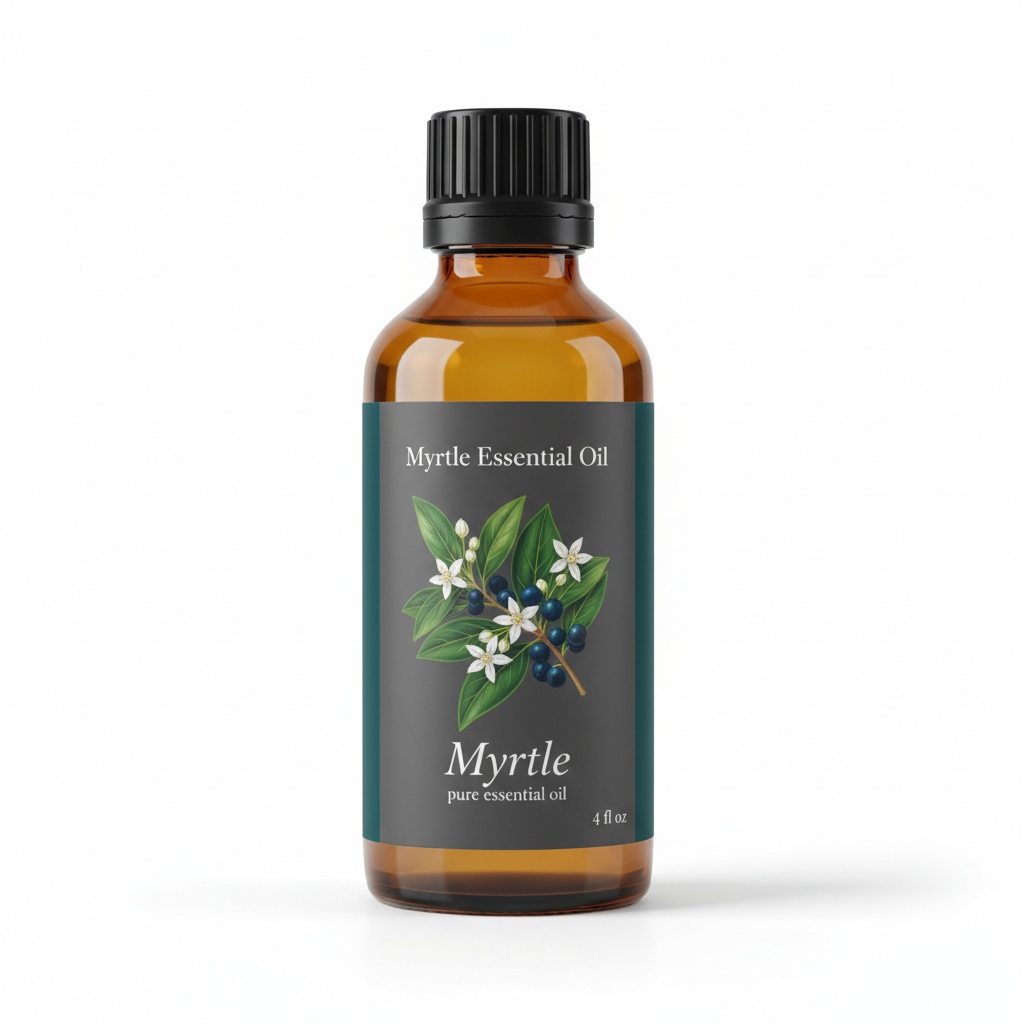
Myrtle Essential Oil
Our own Myrtle Essential Oil, in sizes from 0.5 oz to bulk.
From $16.99
Shop Now →A little planning makes summer easy. Pick one cool shelf for the bottle, one stable table for the diffuser, and keep both well away from the door where the afternoon sun comes in.
Where the bottle lives
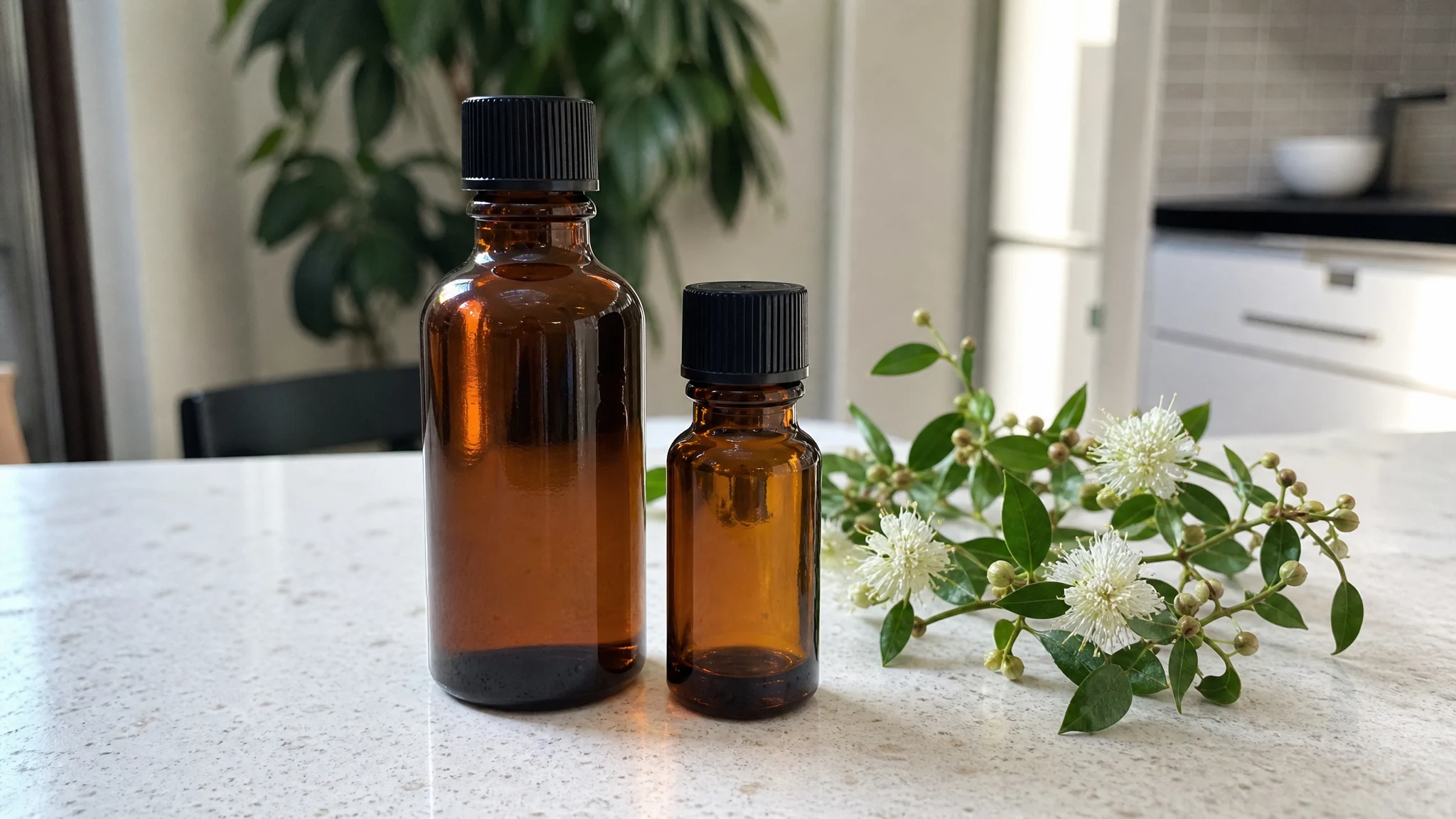
Our guidance on the bottle is simple: keep it tightly capped in a cool, dark place, away from heat and light. A kitchen drawer does the job nicely, and a parked car or a bright sill does not.
There is a small piece of research that backs the habit up. A 2025 study in BMC Plant Biology hydrodistilled myrtle from Iran, sealed it in brown glass vials and held it at 25, 4 and minus 20 degrees Celsius for six months. At ordinary room temperature the two big components, alpha-pinene and 1,8-cineole, held steady, and linalool barely moved. The ester linalyl acetate was the one that dropped most at room temperature. It was one oil in one lab, and it did not test hot windowsills, so we read it as encouragement to treat the bottle gently rather than as a temperature rule. If you want more on keeping an opened bottle in good shape, our storage guide goes further.
Windows open, diffuser on
Summer evenings are good for diffusing, because open windows give you the fresh air that safety guidance asks for anyway. The Tisserand Institute suggests running a diffuser for 30 to 60 minutes and then resting it for 30 to 60 minutes, with some air exchange. Its separate 15 to 20 minute limit is for direct, intensive inhalation such as a steam bowl, not for ambient room scenting. Our home-use guide covers the diffuser side in more detail.
If animals share the porch, the ASPCA says short diffusing in a secured area is not likely to be an issue, that pets with a history of breathing problems may do best without a diffuser, and that birds are best kept away from diffusers entirely. It also reminds owners to keep oils out of paws' reach. For a specific animal, your veterinarian is the right person to ask. Our safety basics post has the rest of the household picture.
Keeping skin blends light
Our myrtle is sold neat, so if you make a body oil you are the one choosing the dilution. Our own guidance is 0.5% to 2% in a carrier oil, with a patch test first, and we treat that as the outer frame rather than a target. Two published figures point lower. A supplier's page quotes Tisserand and Young's maximum dermal level for myrtle as 1.9%. And the fragrance industry limits methyl eugenol, a component myrtle oil can carry, to 0.0015% of a finished body oil or lotion. Methyl eugenol was 0.40% of one supplier's lot and a mean of 1.40% across 19 Algerian sites, so by simple arithmetic the myrtle in a body oil tops out between roughly 0.1% and 0.4%. That is our reasoning from the published caps, not a finding about any particular bottle, but it is why we would begin at the lower end in hot weather, when you may reapply more often and wear more products at once.
Summer sun is also a reason to look at your partner oils. The Tisserand Institute explains that the oils to watch for sun sensitivity are mostly expressed citrus oils, while distilled citrus oils carry far less of the compounds involved; in one comparison, distilled lemon had 22 times less bergapten than expressed lemon. Lemon is a classic partner for myrtle (see our pairing guide), so if you blend for skin, ask your lemon seller whether the oil is distilled or expressed and follow the limits the Tisserand Institute gives for it.
Picking your moment
Hot weather changes how a scent reads. In the heat of the afternoon a fresh, cool-edged aroma like myrtle can feel almost too present, while in the early evening, with the windows open and a breeze moving, it can feel just right. Try it at the end of the day first, with fewer drops than you think you need, and let the breeze do some of the work.
Travel and picnics
If a bottle goes with you on a trip, a day at the lake or a drive, keep it in a bag out of the sun and never leave it in a parked car. A small bottle in a zipped pouch with the cap checked is all it needs. When you get back, return it to its cool, dark shelf and give the cap a quick wipe so the threads stay clean.
Mists and flames
A room or linen mist is a lovely summer format. Alcohol-based sprays are flammable, so spray them well away from candles, grills and cigarettes, and let them dry before you light anything nearby. We walk through the dose for that format in our room spray post.
Keep the bottle in the shade, let the breeze do some of the work, and myrtle will stay a bright, easy companion for the whole season. If you need a constituent report for your own formulation, ask us in writing through the contact page.
Myrtle Essential Oil
Myrtle Essential Oil from our own shop, in sizes from 0.5 oz to bulk.
From $16.99
Shop Now →Sources & Further Reading
- Khosravani et al., Optimizing postharvest quality of myrtle (Myrtus communis L.) essential oil extracts: effects of temperature and storage duration. BMC Plant Biology, 2025
- Tisserand Institute, How to Use Essential Oils Safely
- Tisserand Institute, Phototoxicity: essential oils, sun and safety
- ASPCA, The Essentials of Essential Oils Around Pets
- Hopewell Essential Oils, Myrtle
- Mohamadi et al., Chemical composition and antimicrobial activity of Myrtus communis essential oils from Algeria. Biodiversitas, 2021
- IFRA, The complete IFRA Standards, up to and including the 51st Amendment, methyl eugenol standard