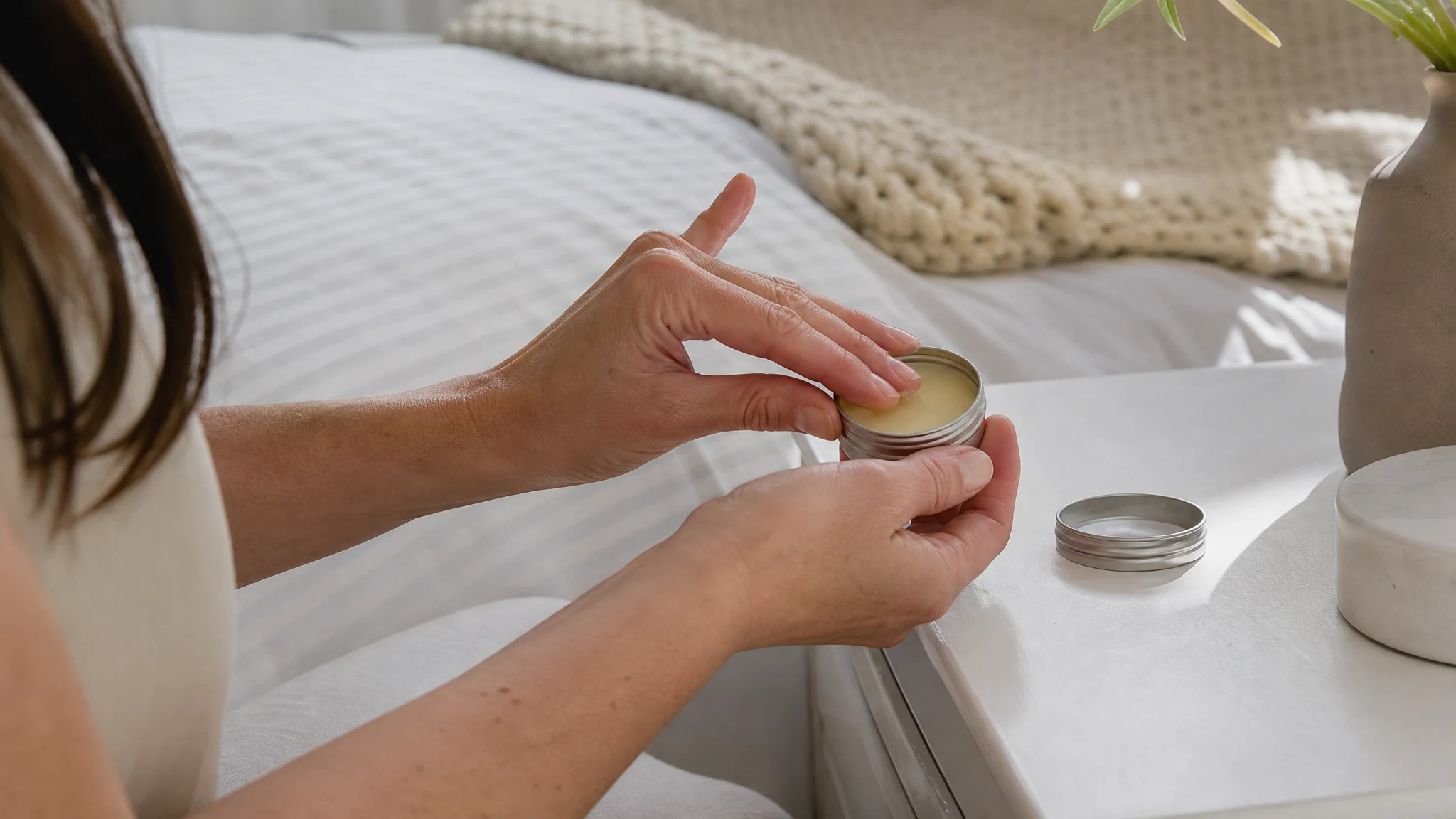
How to Make a Myrtle Scented Balm at Home
A scented balm is one of the nicest ways to carry a fragrance around: a small tin, a swipe of wax and oil, and the cool green note of myrtle on your wrists or shoulders. It is also one of the easiest things to get wrong on dose, because a balm is a leave-on product that sits on skin for hours. Here is a formulation worked out in grams, with the reasoning behind the small amount of oil.
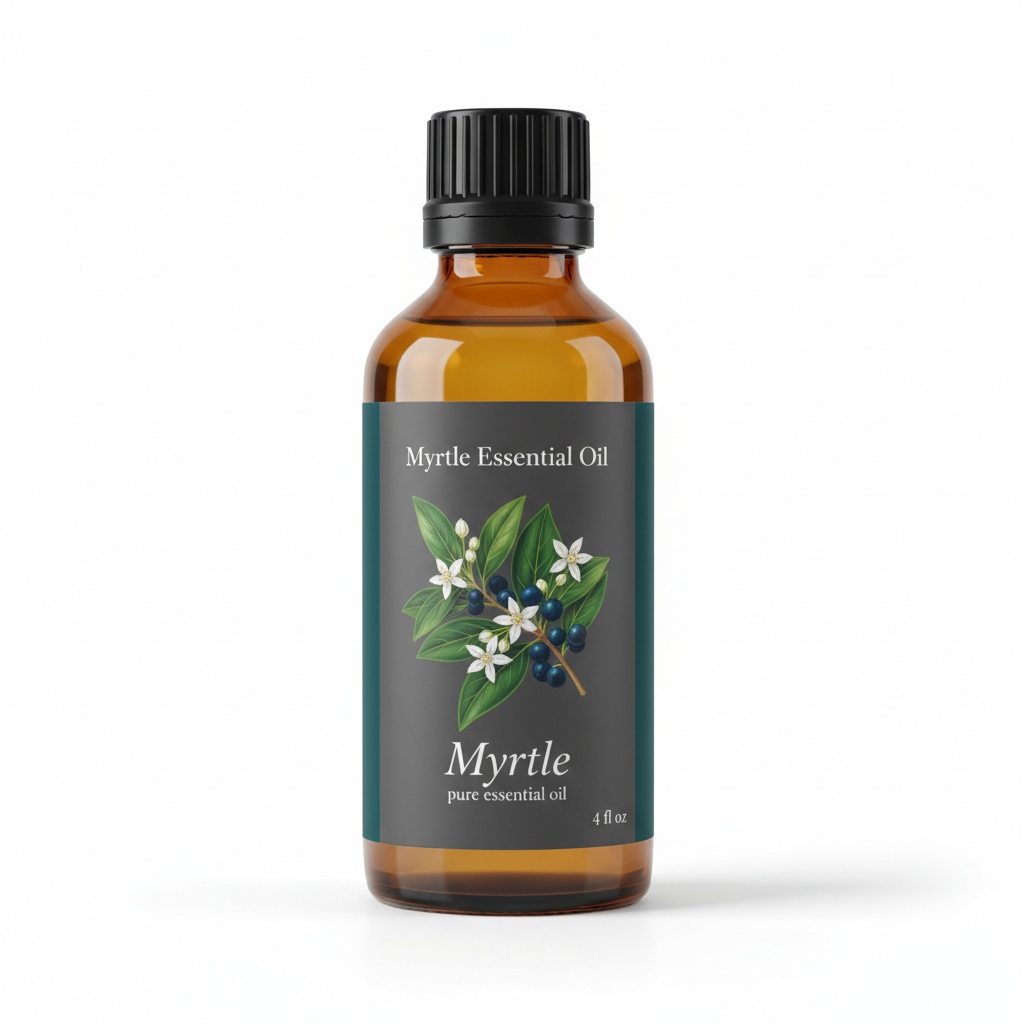
Myrtle Essential Oil
Our own Myrtle Essential Oil, in sizes from 0.5 oz to bulk.
From $16.99
Shop Now →Keep it a fragrance balm
Everything here is a cosmetic fragrance balm for adults. That matters beyond tidiness: the FDA says whether a product counts as a cosmetic or a drug depends on its intended use, and intended use can be shown by claims on the label, in advertising or on the internet. A tin sold as a rub for colds is a different product from a tin sold as a scented balm, however natural the ingredients, and our myrtle oil is an external cosmetic oil. So the tin gets a name, a date and a drop count, and nothing else.
How much myrtle goes in
Our dilution guidance for skin is 0.5% to 2% in a carrier, with a patch test first. For a leave-on balm we start at the bottom, and a little below it, for two reasons.
First, Tisserand and Young's Essential Oil Safety, as quoted by one supplier, gives a maximum dermal level of 1.9% for myrtle oil, just under the top of our range. Second, IFRA has no standard for myrtle oil by name, but it does cap methyl eugenol, a constituent some myrtle oils carry, at 0.0015% of Category 5A products (body lotions and oils). That cap becomes a limit on the oil once you know the constituent share. Take one supplier's red myrtle lot with 0.40% methyl eugenol: 0.0015 divided by 0.40 gives about 0.375% oil. That lot is not ours, and the certificate of analysis we publish for one batch lists no constituents, so we cannot place our oil on that scale. A balm smoothed over the chest and shoulders is closer to body-oil use than to a dab of perfume, which is our reading, and home makers are not bound by IFRA; it is simply the most specific yardstick there is.
So here is the suggestion: 2 drops in a 30 g tin, with 3 as the most.
| One 30 g tin | Grams | Working |
|---|---|---|
| Beeswax pastilles | 6.0 g | 20% of 30 g |
| Liquid carrier oil | 23.9 g | what remains |
| Myrtle oil, 2 drops | 0.09 g | 0.1 ml at about 0.9 g/ml, which is 0.30% |
| Myrtle oil, 3 drops | 0.135 g | 0.45% |
The drop math assumes about 20 drops per ml and a density near 0.9 g/ml; our certificate states a density range of 0.890 to 0.922 rather than a measured value, and droppers vary, so weigh the oil if your scale reads to 0.01 g. The scent will be quiet; if you want more, use a little more balm rather than more drops.
The wax and the carrier
We do not sell beeswax, carrier oils or tins, so pick them up at a craft or supply shop. One supplier lists white beeswax as melting at 62 to 65 C. A ratio of about 1 part wax to 4 parts oil, as above, is our suggestion for a balm that holds its shape in the tin; more wax makes it harder. Jojoba is a lovely carrier and has a specific gravity of about 0.86 to 0.87, so 24 g is roughly 28 ml. If you reach for sweet almond oil instead, remember almonds are a tree nut, so anyone with a nut allergy should choose another carrier.
Making it
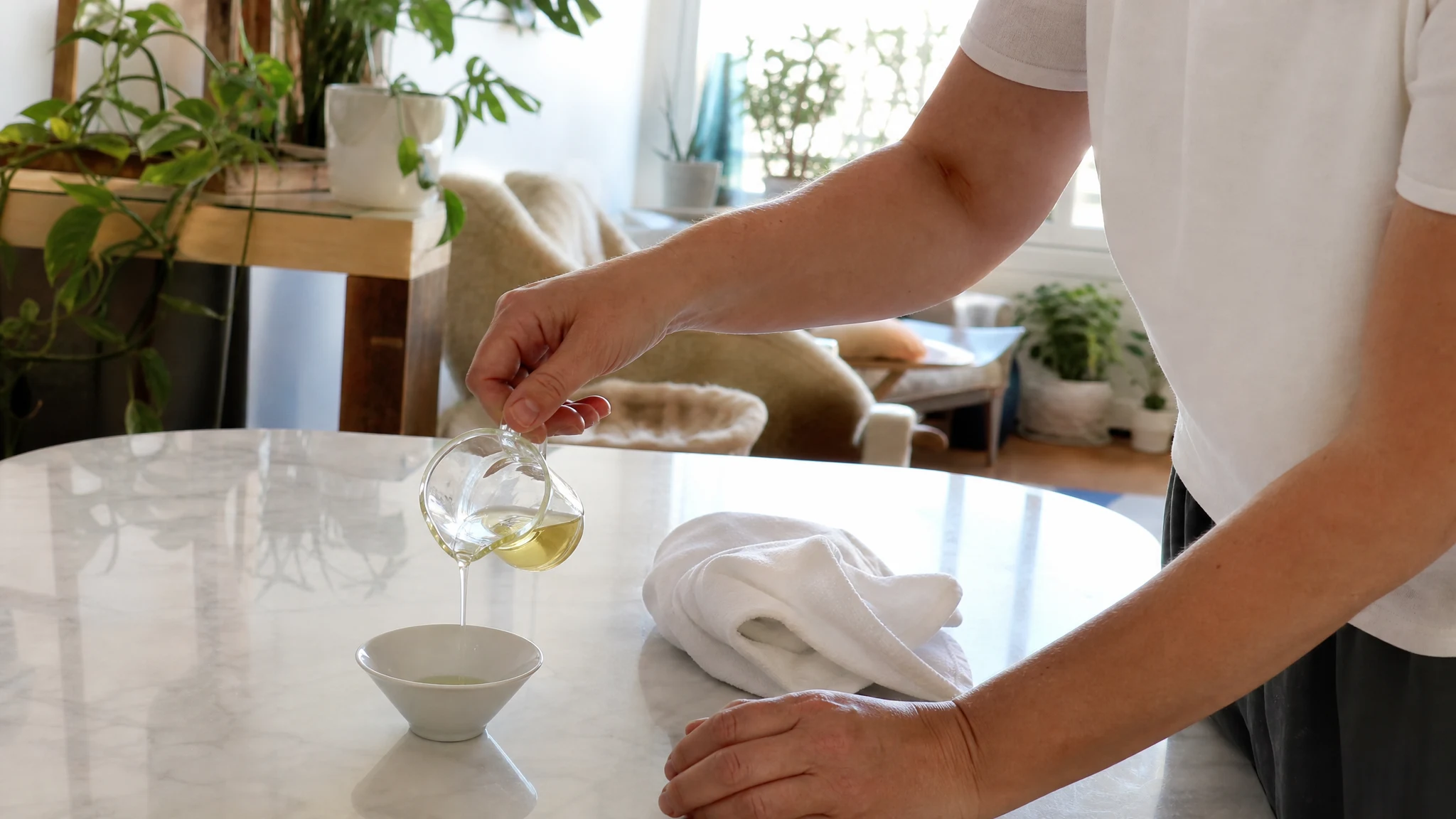
- Weigh the wax and carrier into a heat-proof jar and set it in a pan of hot water, keeping it below a simmer, until clear.
- Take it off the heat and let it cool for a few minutes. Heat drives scent off, so cooling first helps keep the aroma.
- Add the myrtle drops, stir for about thirty seconds, pour into the tin and leave it alone until set.
- Label it with the date and "adults only, keep from children and pets, not for internal use."
Make small batches, since a homemade balm has no stability data behind it; we put the oil alone at typically 2 to 3 years when stored tightly capped, cool and dark.
Choosing a tin
A shallow 30 g tin with a screw lid is easier to scoop from than a deep jar, and a metal or glass one wipes clean. Leave a little headroom when you pour so the balm does not touch the lid. Once it is poured, resist the urge to move it: a balm left alone tends to set with a smooth, flat top, while one jostled during cooling can end up rippled.
Before the first swipe
Patch test. The American Academy of Dermatology describes a quarter-sized spot on the inner arm or elbow bend, applied twice a day for seven to 10 days. If redness, itching or swelling appears, wash it off and stop; a severe reaction, or one where you cannot tell which ingredient is responsible, is a reason to see a board-certified dermatologist. Keep the balm on the skin of the chest and shoulders. It does not belong near the eyes, the lips, the nose or broken skin.
This balm is for adults. We say keep our oil away from children and pets, and we would not make a tin for a child's skin. If you are pregnant or nursing, our pregnancy post covers what the sources say, and your doctor or midwife is the person to ask. The safety basics and our guide to storing myrtle oil cover the rest, and if you would like a lighter format, try the roller blends.
When the balm has set, open the tin and take a moment with the scent before you touch the surface. The wax and carrier oil have a soft smell of their own, and myrtle sits on top of it as a faint, cool green lift. If it seems quiet, that is the dose doing its job.
A small tin that smells of myrtle is a lovely thing to have in a coat pocket.
Myrtle Essential Oil
Myrtle Essential Oil from our own shop, in sizes from 0.5 oz to bulk.
From $16.99
Shop Now →Sources & Further Reading
- Is It a Cosmetic, a Drug, or Both? (Or Is It Soap?) | FDA.
- Myrtle - Hopewell Essential Oils, supplier page quoting Tisserand and Young, with GC/MS for one lot.
- IFRA Standards library, 51st Amendment compilation (methyl eugenol standard), IFRA.
- Guidance for the use of IFRA Standards, IFRA, June 2023 edition.
- White Beeswax - Koster Keunen Waxes.
- Quality Standards - IJEC, International Jojoba Export Council.
- How to test skin care products, American Academy of Dermatology.