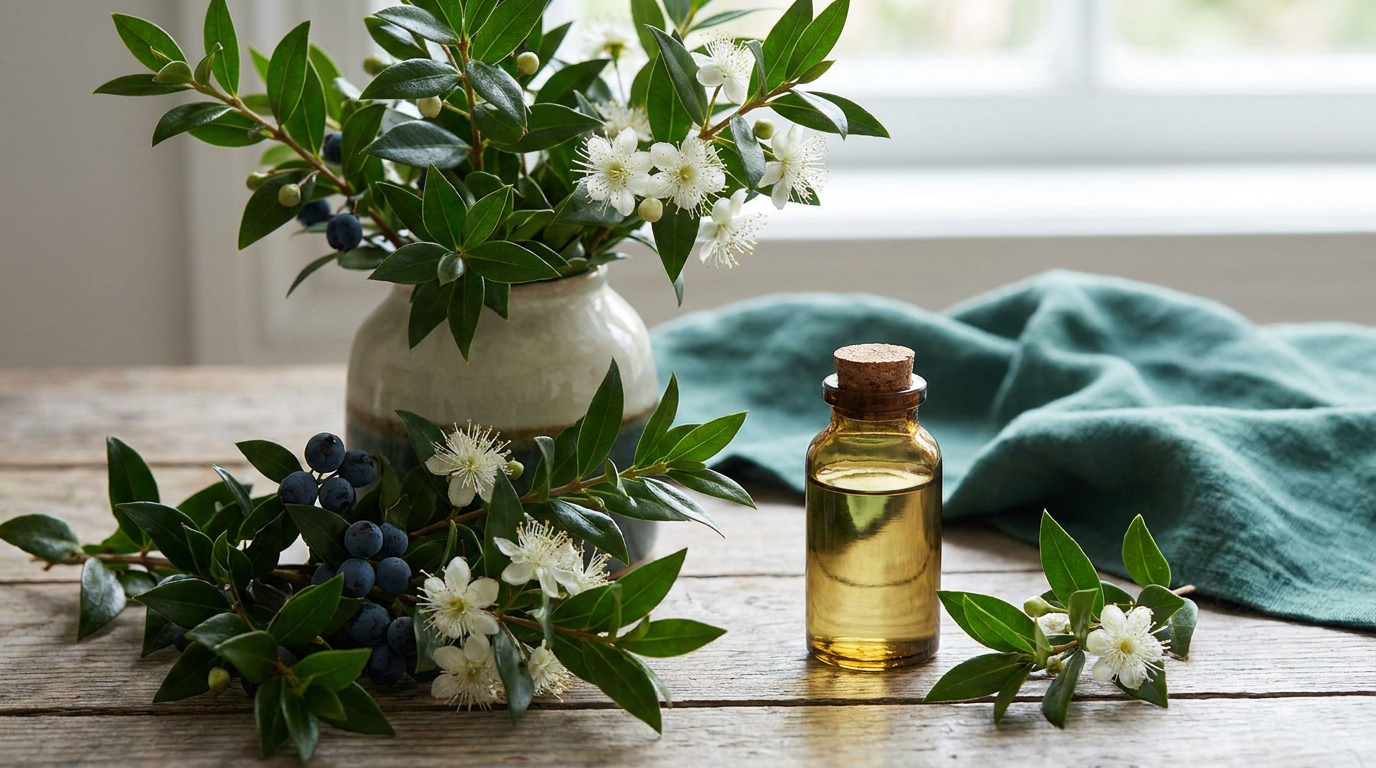
Myrtle Oil in Cold-Process Soap: What to Know
Soapmakers ask the right question about essential oils: will the scent still be there after the lye has done its work and the bars have cured? For myrtle oil there is no published scent-fade study to point to, and what is worth knowing instead is how much myrtle a bar can carry, what the lye side asks of you, and where "soap" stops being soap in the eyes of the law.
Myrtle Essential Oil
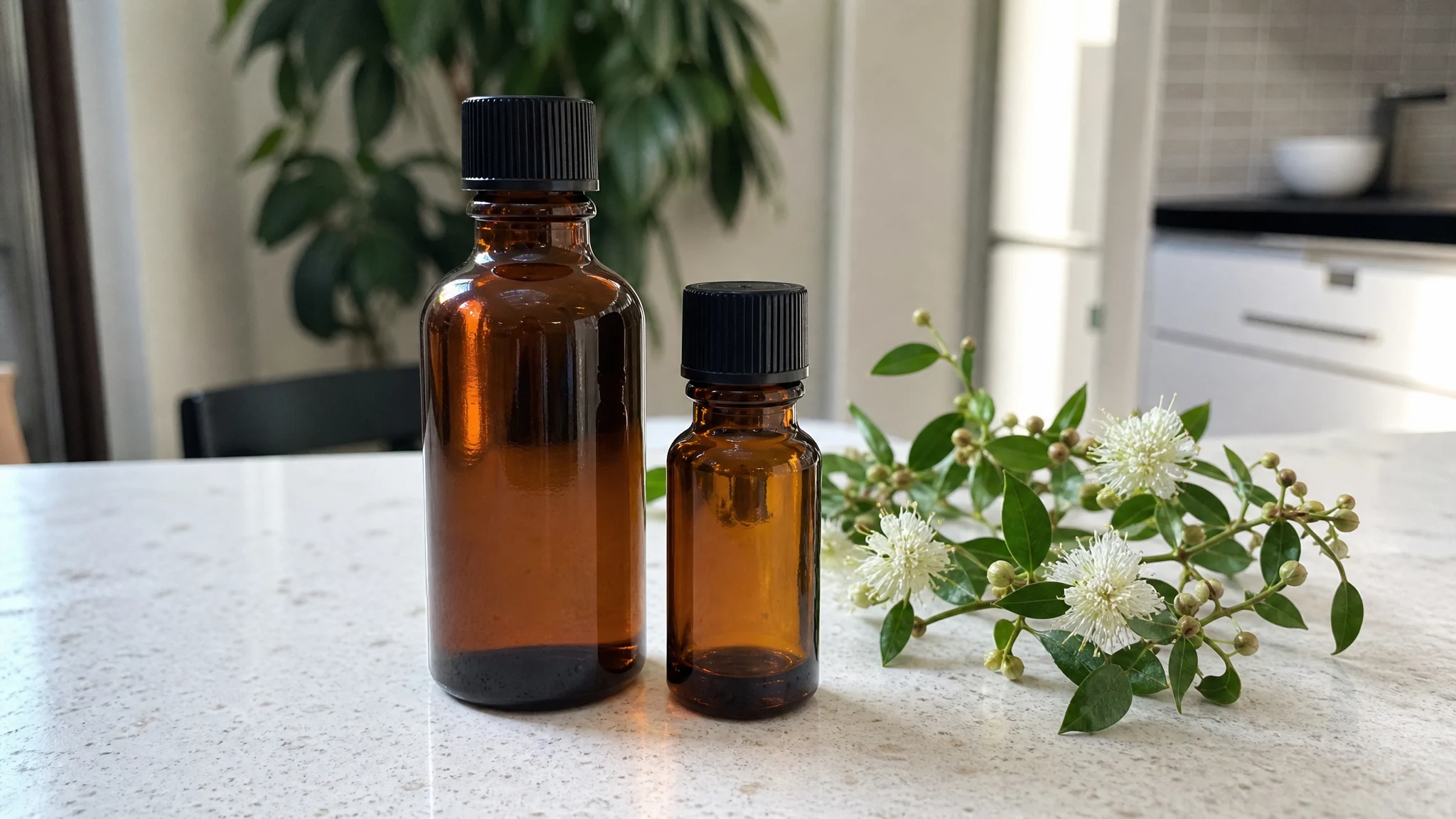
Our own Myrtle Essential Oil, in sizes from 0.5 oz to bulk.
From $16.99
Shop Now →What the soap research does cover
The closest paper we know of is a 2018 study of seven commercial cold-process herbal soaps, four of them made with rosemary extract or essential oil blends. It looked at the fat side of the bar, finding that most polyunsaturated fatty acids stayed unsaponified, and at sensory perception. It did not track how an essential oil's top notes hold up through cure.
Myrtle makes a single prediction harder, because the oil itself varies a great deal. In a Sardinian collection of 52 myrtle genotypes grown in one field, 1,8-cineole in the leaf oil ran from about 1.4% to 27.1%, and myrtenyl acetate from under 1% in most plants to about 28% in a few. If two plants side by side differ that much, two lots of oil can too. So the fair way to learn how myrtle behaves in your recipe is to keep notes on your own lot, which we come back to below.
How much myrtle a bar can carry
IFRA puts bar soap and bath products in Category 9 and caps methyl eugenol, a constituent myrtle oil can carry, at 0.0017% of the finished product. Divide the cap by the share of methyl eugenol in the oil and you have the most oil the bar can hold. Published myrtle samples span 0.2% in a Corsican leaf oil to a mean of 1.40% across 19 Algerian localities, and one Sardinian genotype reached 5.15%.
| Methyl eugenol in the oil | Max myrtle oil in the bar | Per 1,000 g of soap |
|---|---|---|
| 0.2% | 0.85% | about 8.5 g |
| 0.40% | 0.425% | about 4.3 g |
| 1.40% | 0.121% | about 1.2 g |
This is our arithmetic, and IFRA writes its standards for commercial products rather than home batches, but they are the clearest published limit for the ingredient. A fresh, green scent like myrtle's is delicate, so a modest amount is a natural fit anyway: a few grams per kilogram of soap, not several percent. If you want to stay inside the cap, you need a constituent report for the lot you hold. The Certificate of Analysis we publish covers one batch and lists density and refractive index, so ask us in writing through the contact page before ordering if constituents matter to your recipe.
What to look for when you scent a bar
A cured bar is the real test. Hold it close the day you unmold it, then again when it has finished curing, and notice how the character changes. At the modest amounts above, a fresh, green oil like myrtle will be a quiet presence, more a clean, leafy impression than a perfume, and that suits a plain bar well. Partners from our blending list, such as lemon, lavender or rosemary, are a classic way to give a bar a little more body; you will find those at your usual soap-supply shop.
Write down what you notice, not just what you intend. A short note about the first sniff, the sniff after a week and the sniff at the end of the cure is the most useful record a soapmaker can keep.
Respect the lye
Cold-process soap is made with sodium hydroxide, and that is where the real handling care belongs. The CDC's NIOSH Pocket Guide lists it as irritating to eyes, skin and airways, able to burn, with immediate eye irrigation and skin flushing as first aid. Its exposure limit is 2 mg/m3. Follow a reputable soap-supply source for your lye procedure, work with ventilation and eye protection, and keep children and pets out of the room. Lye, soap oils, molds and a recipe all come from a soap-supply shop. We supply the myrtle. Our safety post covers the oil itself.
When a bar is legally soap
If you plan to sell, the wording on the label matters. FDA uses "soap" only for a product whose nonvolatile matter is mostly alkali salts of fatty acids, whose cleaning comes from them, and which is labeled, sold and presented solely as soap. Products that meet this are regulated by the Consumer Product Safety Commission. Claim a cosmetic benefit such as moisturizing, or a treatment benefit such as antibacterial action, and the product moves under FDA as a cosmetic, a drug, or both. A regulatory consultant or attorney is the right guide for a commercial label. We keep our own pages to scent and make no claims about what myrtle does on skin, a stance you can see in our skin post.
Running your own trial
If you want the scent-fade answer, you can generate it for your own recipe.
- Scent a small batch at or under your Category 9 ceiling, with the lot's constituent report in hand.
- Make a control with the same recipe and a different oil, or none, so you compare scent and not batch variation.
- Smell both at fixed checkpoints, such as the day you cut, after a week, and after the cure, and write down the lot number, percentage and what you notice.
- Keep the unused oil tightly capped, cool and dark. Limonene and linalool oxidize with air, and the oxidized forms are the main fragrance allergens among them, as the storage post explains.
Start with a small batch
Our advice to anyone new to a scent is to cut a small test batch first. It uses only a few grams of oil, it asks little of you if the scent is not quite what you pictured, and it teaches you more than a big pour. Keep the leftover oil in its bottle, tightly capped, and cool and dark until the next round.
Your notes would be the first myrtle-in-soap record for your own recipe, and a pleasantly specific thing to hold.
Myrtle Essential Oil
Myrtle Essential Oil from our own shop, in sizes from 0.5 oz to bulk.
From $16.99
Shop Now →Sources & Further Reading
- Prieto Vidal et al., The Effects of Cold Saponification on the Unsaponified Fatty Acid Composition and Sensory Perception of Commercial Natural Herbal Soaps, Molecules, 2018. PubMed 30223479
- Usai et al., Chemotaxonomic Evaluation by Volatolomics Analysis of Fifty-Two Genotypes of Myrtus communis L., Plants, 2020. PMC7650784
- International Fragrance Association, IFRA Standards, 51st Amendment (methyl eugenol standard). ifra-standards-51st-amendment.pdf
- International Fragrance Association, Guidance for the Use of IFRA Standards (June 30, 2023). ifra-51st-amendment-guidance-for-the-use-of-ifra-standards.pdf
- Hardy et al., Quorum-Quenching Activity of Myrtus communis Corsican Essential Oil Against the Marine Bacterium Aliivibrio fischeri, Microorganisms, 2025. PMC12195544
- Mohamadi et al., Chemical composition and antimicrobial activity of Myrtus communis essential oils from Algeria, Biodiversitas, 2021. smujo.id/biodiv/article/view/7327
- CDC NIOSH Pocket Guide to Chemical Hazards, Sodium hydroxide. cdc.gov/niosh/npg/npgd0565.html
- FDA, Is It a Cosmetic, a Drug, or Both? (Or Is It Soap?). fda.gov
- Uter, Contact allergy to fragrances: current clinical and regulatory trends, Allergologie Select, 2017. PMC6040011