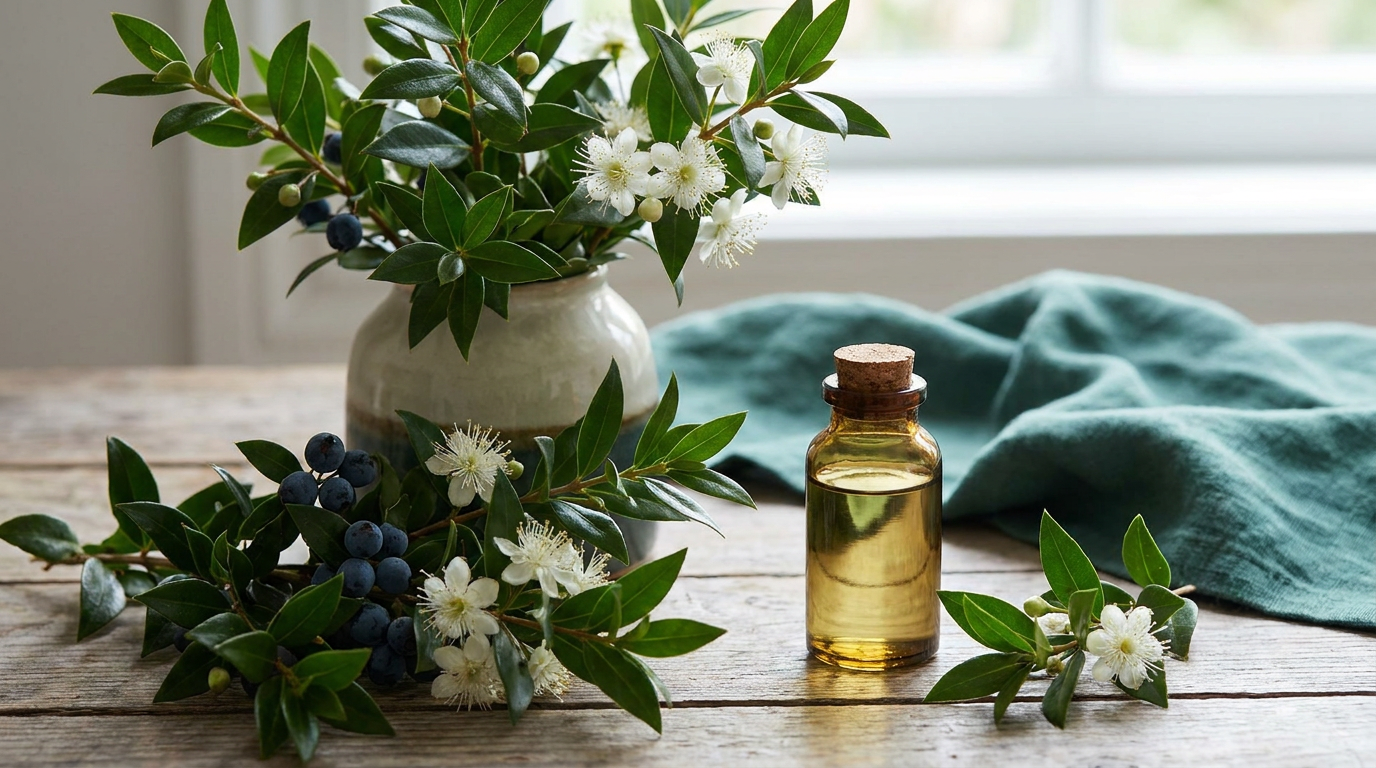
A Soapmaker's Myrtle Trial: Cold Process Notes and Scent Fade
Lavender gets all the attention in cold process forums. So does litsea cubeba, peppermint, and the citrus family when soapmakers talk about oils that hold their scent through saponification. Myrtle essential oil rarely comes up, which is a little strange given how distinctive it smells: bright, green, faintly camphoraceous, somewhere between bay leaf and eucalyptus with a soft fruity edge underneath. We wanted to know whether that opening act survives the alkaline environment of cold process soap, or whether it fades out before the bars ever reach a shop shelf. So we ran a small in-house batch trial and kept a scent journal through the entire aging period.
Myrtle Essential Oil
Our own Myrtle Essential Oil, in sizes from 0.5 oz to bulk.
From $14.99
Shop Now →This is not a lab study and it is not a claim about what myrtle oil does for skin. It is a set of working notes from one soapmaker's bench, offered so other hobbyists and small-batch makers have a starting reference before they spend money on a bottle of myrtle oil for a fragrance project.
Why Myrtle Rarely Shows Up in Soap Recipes
Part of the reason is availability. Myrtle essential oil is a smaller crop than lavender or eucalyptus, and pricing reflects that. Part of it is chemistry. Myrtle leans on 1,8-cineole and myrtenyl acetate for its character, and both of those compounds are volatile, meaning they evaporate readily. Volatile top notes are notorious for fading in finished cold process soap, where the fragrance has to survive a hot, high-pH saponification reaction and then several weeks of open-air aging before the bar is ever used.
Sourcing also matters more than most recipes acknowledge. Myrtle grown in Corsica tends to read sweeter and greener, while material from Morocco or Tunisia can lean more medicinal and sharp depending on the chemotype and distillation batch. Two bottles labeled simply "myrtle essential oil" can smell noticeably different from each other before a single drop touches lye. We used a single-origin batch for this trial and noted the supplier so the results are at least internally consistent, even if they would not necessarily repeat with a different sourcing lot.
Setting Up the Trial
Batch Design
We built three small batches from the same base recipe: an olive, coconut, sustainable palm alternative, and castor oil blend at a standard water discount, hand-stirred to a light trace. Only the fragrance load and blend changed between batches:
- Batch A: myrtle essential oil alone, at a conservative 0.5 oz per pound of oils
- Batch B: myrtle essential oil alone, at a fuller 1 oz per pound of oils, near the upper end of what most soap-safe usage guidance allows for a rinse-off product
- Batch C: myrtle essential oil blended with a small amount of patchouli, added as a heavier, less volatile note meant to anchor the lighter top notes
We stayed under published skin-safe usage limits for rinse-off soap in every batch, and we did not push toward anything experimental. Anyone repeating a trial like this at home should look up current dilution guidance for the specific essential oil before scaling up a recipe, since safe usage rates vary by oil and by product type.
Note-Taking Method
We rated scent strength on a simple 1 to 5 scale (1 being barely perceptible, 5 being strong straight out of the mold) and recorded it at four checkpoints: at trace, at unmold (24 hours later), at the one-week mark, and again at four and eight weeks into the aging period. We also noted any color shift, any acceleration in trace, and any separation or speckling in the bars.
Batch B, day 1 journal note: "Strong, almost sharp on unmolding. Green and slightly medicinal, more eucalyptus-forward than the bottle smelled on its own. No visible acceleration at trace."
Observations
The scent strength numbers told a fairly clear story once we lined them up side by side.
| Batch | Trace | Unmold (24 hrs) | Week 1 | Week 4 | Week 8 |
|---|---|---|---|---|---|
| A (0.5 oz/lb, myrtle only) | 3 | 3 | 2 | 1 | 1 |
| B (1 oz/lb, myrtle only) | 4 | 4 | 3 | 2 | 1 |
| C (myrtle + patchouli blend) | 4 | 4 | 4 | 3 | 2 |
Both myrtle-only batches lost noticeable strength by the one-week mark, which lines up with what would be expected from a top-note-heavy oil going through an alkaline reaction. By week four, Batch A had faded to something we could only detect by holding the bar close and inhaling directly. Batch B held on a little longer, which makes sense given the higher starting concentration, but the drop-off between week one and week four was steep in both cases. Batch C, the blend with patchouli, retained a soft green whisper of myrtle even at eight weeks, layered under the deeper base note. That result matches a pattern soapmakers report anecdotally across many essential oil families: pairing a volatile top note with a heavier, less volatile oil seems to extend how long the lighter note is perceptible, even though the top note itself is still fading at roughly the same underlying rate.
None of the batches showed acceleration, ricing, or seizing at trace, and no meaningful color shift appeared beyond the pale, slightly warmer tone typical of an olive oil base as it ages. That is a reasonably favorable sign for myrtle oil's behavior in a cold process environment, even if the scent itself did not last as long as we hoped.
What This Suggests About Myrtle Oil Soap Making Notes
A handful of practical takeaways came out of this trial, offered as observations rather than settled fact, since a single batch run on one origin lot is a small sample:
- Expect myrtle to behave like a top note. It announces itself strongly in the first days after unmolding and fades from there, often faster than heavier woods or resins would in the same base recipe.
- Blending extends the perceived life of the scent. Anchoring myrtle with a lower-volatility oil like patchouli, or potentially benzoin or a resinous note, seemed to slow how quickly the overall fragrance read as "gone," even though the myrtle component itself was still fading underneath.
- Doubling the usage rate did not double the scent life. Batch B started stronger than Batch A but converged toward a similar faint presence by week eight. Usage rate mattered more for initial strength than for long-term retention.
- Sourcing and chemotype likely shift these results. A cineole-forward myrtle oil, like the one used here, read brighter and sharper early on. A sweeter, ester-forward chemotype might fade differently. Soapmakers repeating this kind of trial should track the supplier and, where available, the chemotype on the label.
- No processing red flags appeared. Trace behavior, color, and bar texture were unremarkable across all three batches, which suggests myrtle oil is workable in a standard cold process recipe without special handling.
Safety and Dilution Notes for DIY Soap Projects
A few reminders worth repeating for anyone planning their own myrtle oil soap making notes or a similar small-batch trial. Essential oils are concentrated, and usage rates for rinse-off products like soap are generally lower than what some recipes floating around online suggest. Look up current safe usage guidance for the specific oil before formulating, and weigh fragrance loads by percentage of total oils rather than eyeballing drops.
Always patch test a finished bar on a small area of skin before using it regularly, and give any new soap recipe a full aging period of several weeks before that patch test, since the pH continues to mellow during that time. Anyone with known skin sensitivities, anyone pregnant, and anyone formulating for children should look into oil-specific contraindications before adding a new essential oil to a recipe. If irritation shows up after a patch test, discontinue use of that bar. None of this trial's notes are a substitute for professional guidance on formulation safety, and a qualified aromatherapist or cosmetic chemist is a better resource than a soap forum for anything beyond casual hobby use.
Where This Leaves Our Notes
Myrtle essential oil is workable in cold process soap and behaves predictably at trace, but on its own it is not a long-haul scent. If the goal is a bar that still smells distinctly of myrtle two months after cutting, a blend with a heavier fixative note looks like the more promising direction based on what we saw here. If the goal is a brighter, more fleeting green top note meant to be enjoyed in the first weeks after a bar comes out of the mold, myrtle alone does the job well. We plan to run a second trial testing a higher patchouli ratio and a different myrtle sourcing lot to see how much of this pattern holds. For now, these notes are offered as a starting point, not a final answer, for anyone curious about how this underused oil performs on the workbench.